
How Indian IT Businesses Can Choose SOC Managed Services Providers
Indian IT businesses are managing increasingly distributed technology environments. Cloud platforms, remote employees, SaaS applications, endpoints, business applications, and connected infrastructure all generate security events that require attention. For organizations trying to strengthen their security posture without expanding internal teams indefinitely, soc managed services providers can offer a practical way to access continuous monitoring and security expertise.
The decision, however, should not be based on technology alone. IT leaders need to evaluate monitoring capability, incident response, integration, expertise, scalability, reporting, and the provider's ability to work alongside existing teams.
What Are SOC Managed Services Providers?
SOC managed services providers operate security operations capabilities for organizations that need continuous threat monitoring, investigation, and response without managing every SOC function internally.
A managed SOC combines security technology, monitoring processes, threat analysis, and human expertise to identify suspicious activity and support an appropriate response.
For Indian businesses, this model can be particularly useful when internal IT teams are responsible for security alongside infrastructure, cloud administration, application support, and business continuity.
Why SOC Managed Services Providers Matter for Indian Businesses
Cybersecurity threats do not follow business hours. Security events can occur when internal teams are handling other priorities, working across different locations, or unavailable for investigation.
A mature security operation requires more than installing security tools. It requires people who understand alerts, processes for escalation, defined responsibilities, and continuous improvement.
Managed SOC services can provide an additional security operations layer while allowing internal leaders to retain control over risk decisions and remediation.
The Pressure on Indian IT Security Teams
Indian technology businesses often support customers across multiple locations and time zones. Their environments may include public cloud platforms, private infrastructure, employee devices, identity systems, development environments, and customer-facing applications.
Every additional technology layer can create more security telemetry.
The challenge is not simply collecting this information. The challenge is determining which activity deserves immediate attention.
Security teams may also face a shortage of specialist resources. Recruiting experienced analysts, maintaining round the clock coverage, managing shifts, and keeping security knowledge current can become difficult as an organization grows.
For smaller and mid-sized businesses, building a dedicated SOC may not be practical. Larger organizations may already have an internal SOC but need additional expertise, coverage, or operational capacity.
Why an Internal Only Approach Can Become Difficult
An internal SOC provides direct control, but it also creates substantial operational responsibilities.
The organization must recruit security professionals, maintain monitoring technologies, develop detection processes, investigate alerts, establish escalation procedures, and continually improve its security capabilities.
There is also the challenge of maintaining consistent coverage.
Security monitoring requires continuity. A small team can struggle with workload, leave, employee turnover, and the need to investigate incidents while simultaneously maintaining routine operations.
This does not mean internal SOCs are ineffective. Organizations with mature security teams may prefer internal control. The important question is whether the current model can provide the required level of coverage and expertise as the business evolves.
How a Managed SOC Works
A managed SOC typically begins by understanding the organization's technology environment and security priorities.
Relevant security events are collected from appropriate systems and monitored through security technologies. Analysts review alerts and investigate suspicious behavior.
Threat intelligence can add context to security events and help analysts understand whether activity is associated with known or emerging threats.
When an incident requires action, escalation procedures determine which internal stakeholders need to be informed and what response responsibilities belong to each party.
Ongoing reporting helps security leaders understand incidents, recurring risks, and areas where security controls may need improvement.
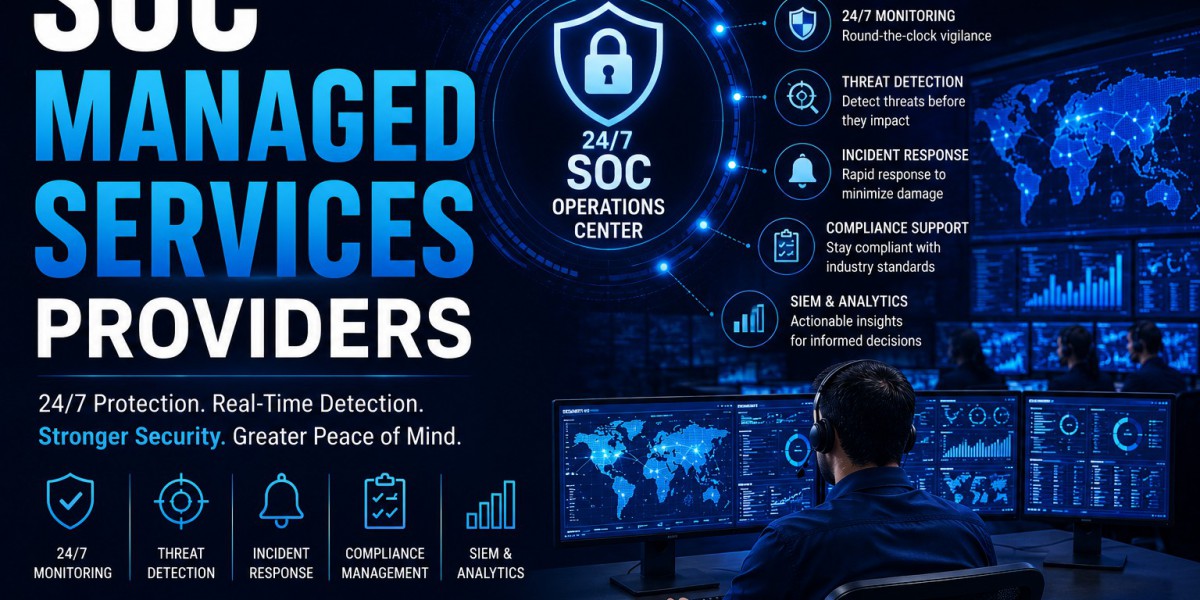
IBN Technologies provides managed SOC and SIEM services that include continuous monitoring, threat detection, incident response, threat intelligence, compliance reporting, and security device monitoring.
What Should IT Leaders Look For
Choosing a SOC provider requires a practical assessment of the organization's current environment and future requirements.
Monitoring coverage should be clearly defined. Leaders should understand which cloud environments, endpoints, networks, applications, and infrastructure components can be monitored.
Incident response should also be clearly documented. A provider should explain how critical alerts are investigated, escalated, and communicated.
Integration matters because most organizations already have security tools in place. The managed SOC should complement existing infrastructure wherever possible.
Reporting is another important consideration. Executive stakeholders need understandable information about security risks rather than a constant stream of technical alerts.
Scalability should also be considered. The provider should be able to support changes in users, infrastructure, cloud adoption, applications, and business operations.
The Business Value of Managed SOC Services
The primary value of managed security operations is improved security coverage.
Instead of depending entirely on internal employees to monitor security events, an organization can use a specialist security team to support continuous monitoring and investigation.
This can reduce operational pressure on IT staff and allow them to focus on infrastructure, applications, cloud operations, and business requirements.
Managed services can also give organizations access to specialist cybersecurity knowledge without requiring them to build every SOC function internally.
For growing businesses, this flexibility can be important. Security requirements can increase as the organization expands, but staffing a complete security operation at the same pace may not always be practical.
An Indian IT Business Scenario
Consider an Indian software company supporting enterprise customers across several regions.
Its infrastructure has expanded from a small on premises environment into a combination of cloud workloads, employee endpoints, identity services, development platforms, and customer applications.
The internal IT team understands the business and technology environment but has limited capacity for continuous security investigation.
A managed SOC can monitor relevant security activity, investigate suspicious events, and escalate serious incidents according to predefined procedures.
The internal team remains responsible for business decisions and remediation while the security provider contributes specialist monitoring and investigation capabilities.
Best Practices for Evaluating a Provider
Before selecting a managed SOC partner, IT leaders should establish clear requirements.
Define the systems that require monitoring.
Identify critical applications, infrastructure, cloud workloads, endpoints, identity systems, and network assets.
Clarify incident responsibilities.
Determine which actions the provider can take independently and which require internal approval.
Establish escalation expectations.
Define how critical security events should be communicated and who needs to receive notifications.
Review reporting requirements.
Ensure security reports are useful for technical teams, management, and compliance stakeholders.
Assess integration capability.
Confirm whether the provider can work with the organization's existing security technologies.
Evaluate scalability.
Consider how the service will support future changes in infrastructure, cloud adoption, applications, and workforce size.
Measure operational value.
Evaluate the provider based on visibility, response capability, security maturity, and business outcomes rather than alert volume alone.
Compliance and Governance in India
Security operations should support broader governance and compliance requirements.
Depending on the organization's sector, customers, data, and operating model, relevant requirements may include ISO 27001, the Digital Personal Data Protection Act, PCI DSS, SOC 2, GDPR, RBI requirements, and SEBI requirements.
A managed SOC can contribute to compliance by providing continuous monitoring, security records, incident information, and compliance oriented reporting.
However, compliance cannot be achieved through SOC monitoring alone. Organizations also need appropriate policies, access controls, vulnerability management, risk assessments, incident response procedures, employee awareness, and governance.
IBN Technologies provides cybersecurity audit and compliance services covering frameworks and requirements including ISO 27001, GDPR, SOC 2, HIPAA, PCI DSS, RBI, SEBI, IRDAI, and DPDPA.
Creating a Stronger Security Operations Model
Indian IT businesses need security operations that can keep pace with changing technology without creating unsustainable pressure on internal teams. A managed model can provide continuous monitoring and specialist expertise while allowing internal IT and security leaders to retain business context and governance.
The right soc managed services providers should therefore be assessed as long term security operations partners rather than simply technology suppliers. For organizations seeking continuous monitoring, incident response, threat intelligence, and scalable security operations, IBN Technologies can be evaluated as part of a broader cybersecurity strategy.
Contact Us:
IND- 02067680404
IBN Technologies Ltd.
E-mail: - sales@ibntech.com