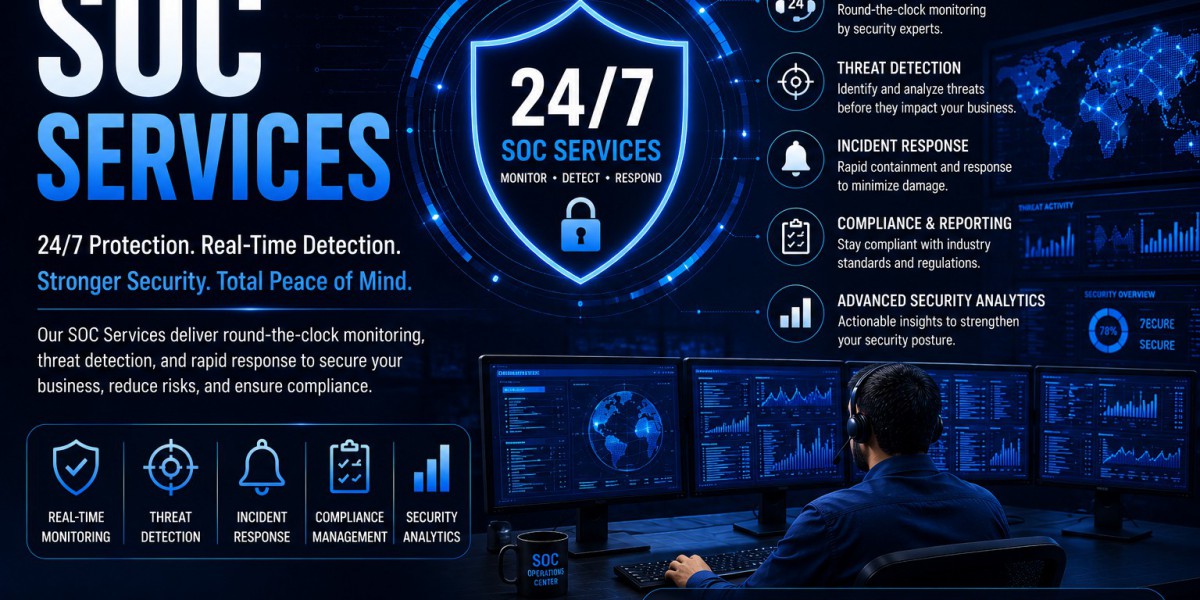

Why soc services matter for modern IT environments
soc services provide continuous security monitoring, threat detection, investigation, and response for an organisation's technology environment. They can be delivered through an internal security operations function, a managed provider, or a combination of both, depending on the organisation's risk, skills, infrastructure, and operating requirements.
For Indian IT businesses, the decision is increasingly operational rather than theoretical. Cloud adoption, distributed workforces, SaaS platforms, APIs, endpoints, and third-party integrations can generate security events across an environment that is difficult for a small internal team to watch continuously.
The real business problem behind soc services
Security incidents rarely respect office hours. An organisation may have strong endpoint protection and network controls yet still face risk if suspicious activity is not investigated promptly or if alerts are handled inconsistently.
This creates a distinction between having security technology and operating security effectively. A SIEM platform can collect and correlate events, but someone still needs to determine which activity deserves attention, investigate the context, and coordinate an appropriate response.
For an Indian software company serving enterprise customers, this operational capability can also influence commercial confidence. Customers may ask how their supplier monitors threats, handles incidents, protects privileged accounts, and maintains evidence for security reviews.
Why an internal-only approach can become difficult
Building an internal security operation gives an organisation direct control over processes and technology. It can be appropriate for businesses with established security teams, specialised skills, sufficient staffing, and a need for extensive customisation.
The challenge is maintaining that capability consistently. Security operations involve more than purchasing a SIEM platform. Teams need monitoring processes, alert triage, incident investigation, escalation procedures, threat intelligence, reporting, and ongoing tuning.
Staffing can be another constraint. A small IT security team may already be responsible for identity, infrastructure, vulnerability management, cloud security and compliance. Asking the same people to provide continuous monitoring can create competing priorities.
A managed security operations center can address part of this operational burden by providing specialist monitoring and response capabilities without requiring the organisation to establish every function internally.
What a managed model should actually provide
A useful managed service should connect technology with human analysis. Continuous monitoring is valuable only when alerts can be assessed against business context and escalated according to defined procedures.
IBN Technologies' SOC and SIEM offering includes continuous monitoring, threat intelligence, incident response, and audit-ready reporting. Its broader cybersecurity portfolio also includes managed detection and response, VAPT, vCISO services, Microsoft security services, and cybersecurity maturity and risk assessment.
The appropriate combination depends on the organisation's environment. A company with strong internal analysts may need additional monitoring capacity, while a smaller business may require a broader managed security function.
How soc services operate in practice
The operating model generally begins with identifying the systems and data sources that require visibility. These may include cloud workloads, endpoints, identity systems, network infrastructure, applications, and other relevant security telemetry.
Events are then collected and analysed so that potentially suspicious activity can be distinguished from routine system behaviour. When an alert warrants investigation, analysts assess the context and follow an agreed escalation and response process.
Reporting is another important element. Management needs visibility into incidents, recurring patterns, unresolved risks, and the effectiveness of security controls rather than receiving a long list of disconnected technical alerts.
Evaluating managed security operations center providers
The provider selection process should start with coverage rather than marketing language. IT leaders should establish which assets need monitoring, what operating hours are required, who owns incident decisions, and how escalation will work.
Technology compatibility is equally important. A provider should be able to explain how its service will integrate with the organisation's existing security stack and what happens when telemetry is incomplete or an important system changes.
Organisations should also examine the distinction between detection and response. Finding suspicious activity is only one part of the process. The service model should make clear how incidents are investigated, communicated, contained, and handed back to the internal team.
Where soc services create practical value
The most immediate benefit is improved security visibility. Instead of relying on periodic reviews, an organisation can establish an ongoing process for identifying potentially harmful activity.
There can also be a workload benefit for internal IT teams. Routine monitoring and alert analysis can be supported externally, allowing internal specialists to concentrate on architecture, remediation, identity, cloud security, application security, and business priorities.
A mature service can also improve consistency. Defined escalation paths and reporting processes make it easier for management to understand security activity and for teams to respond according to an established operating model.
A realistic Indian IT use case
Consider an Indian technology company operating a cloud-based application for business customers. Its infrastructure has expanded across cloud services and employee endpoints, while the internal IT team has remained relatively lean.
The company has security tools installed but receives more alerts than its team can investigate consistently. Some events are reviewed immediately, while lower-priority alerts can remain unresolved because infrastructure and application work takes precedence.
The company evaluates a managed model. The engagement begins with identifying relevant log sources and defining escalation responsibilities. Continuous monitoring is then combined with incident response and reporting, while the internal team retains ownership of remediation and business decisions.
The result is not simply more alerts. The organisation gains a repeatable process for determining which events matter, who needs to act, and what evidence should be retained.
Best-practice checklist for IT leaders
Define critical assets before selecting monitoring coverage
Map cloud, endpoint, identity, network and application telemetry
Establish clear incident severity and escalation rules
Decide which actions require internal approval
Review alert quality rather than measuring activity by alert volume
Require regular reporting that management can understand
Test incident escalation procedures periodically
Connect monitoring findings with vulnerability remediation
Review access to security logs and administrative systems
Reassess coverage whenever infrastructure materially changes
India compliance and governance context
Security monitoring can support broader compliance and governance programmes, but it should not be presented as automatic compliance with every applicable regulation. The relevant framework depends on the organisation's sector, customers, contractual commitments, data processing activities, and technology environment.
IBN Technologies lists compliance management and audit services alongside SOC 2 compliance, ISO 27001-related security capabilities, and support for regulatory requirements including GDPR, DPDPA, RBI and SEBI requirements. Organisations should determine which obligations actually apply before defining their monitoring and reporting scope.
For IT businesses, security operations can also contribute useful evidence for internal governance and customer assurance. The value increases when monitoring records, incident handling, access controls, and remediation activities are connected rather than managed as separate compliance tasks.
Questions to ask before outsourcing security operations
Before selecting a provider, decision-makers should understand exactly what is monitored and what remains outside scope. They should ask how alerts are prioritised, how incidents are escalated, and how the provider works with internal IT and security personnel.
It is also useful to examine reporting frequency, onboarding requirements, integration capabilities, response responsibilities, and the process for changing monitoring coverage as the environment evolves.
The strongest model is rarely the one with the largest technology stack. It is the one that gives the organisation dependable visibility, clear accountability and a practical path from detection to action.
For Indian IT businesses, soc services can become a strategic operating capability when they are designed around real infrastructure, defined responsibilities, and measurable security workflows rather than treated as another software purchase.
Contact Us:
IND- 02067680404
IBN Technologies Ltd.
E-mail: - sales@ibntech.com