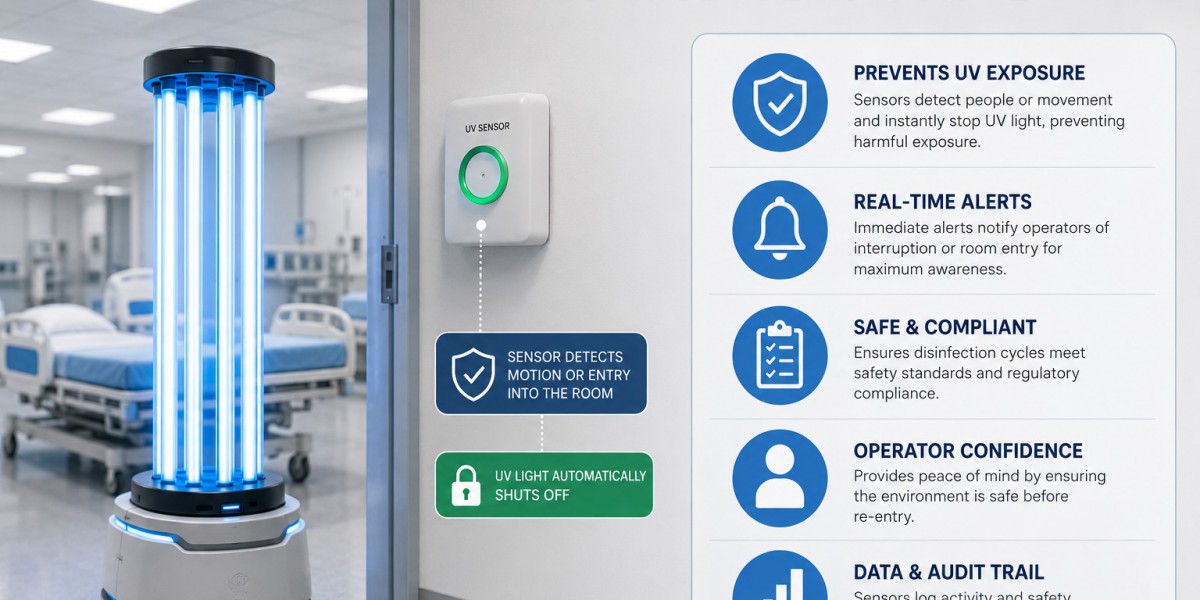

UV disinfection sensors play an important role in making whole-room microbial reduction safer for healthcare workers. UV-C and other germicidal ultraviolet energy can damage microorganisms, but direct exposure to germicidal UV light should be avoided. Xenex addresses this concern in its LightStrike technology with motion-detection sensors designed to immediately stop the device when motion is detected.
For hospitals using whole-room UV disinfection, safety is not separate from the cleaning workflow. It is an essential part of how the technology is operated, monitored, and integrated into Environmental Services (EVS) procedures.
Why Is Operator Safety Important With UV Disinfection?
Ultraviolet light is useful for microbial reduction because certain UV wavelengths can damage microorganisms. However, people should not be directly exposed to the germicidal UV light produced during an active disinfection cycle.
Xenex specifically states that people should not be directly exposed to LightStrike's UV light and describes multiple safety measures designed to support safe operation.
This makes operator safety protocols, motion detection, room preparation, and safety checks important components of a hospital's UV disinfection program.
The goal is straightforward: allow healthcare staff to use high-intensity UV technology while minimizing the possibility of accidental exposure.
How Do UV Disinfection Sensors Work?
A UV disinfection sensor monitors the area around the equipment for movement.
On Xenex LightStrike devices, the system includes motion detection sensors that immediately stop the device when motion is detected.
In practical terms, the safety mechanism works as an additional layer:
Room preparation → Safety check → UV cycle starts → Motion detected → Device stops
This provides an automated response if movement is detected while the UV cycle is operating.
The technology is therefore designed to reduce the possibility that a person could accidentally enter the treatment area while high-intensity UV light is being emitted.
What Sensors Are Used in LightStrike Technology?
Xenex identifies intelligent motion detection as a feature of its LightStrike technology. Its product information also describes a smart cone with a timer and onboard cone charging.
For LightStrike+, Xenex specifically states that sensors immediately stop the device when motion is detected.
This sensor-based approach is important because a UV disinfection device may be operating in environments where hospital staff are continuously moving between rooms, corridors, nursing stations, and patient-care areas.
An automated safety response can therefore provide an additional safeguard beyond the operator's initial room check.
Do Sensors Replace Safety Procedures?
No. Sensors are an additional safety feature, not a substitute for proper operating procedures.
Xenex emphasizes that even with autonomous products, operators still need to follow safety protocols. The company states that operators must be present while the UV product is in operation and should complete safety checks and initiate each cycle according to the required procedure.
This distinction is important.
A hospital should not assume that motion detection makes it acceptable to ignore established UV safety procedures. Instead, sensors should work together with:
Staff training
Room clearance
Safety checks
Proper device positioning
Door procedures
Manufacturer instructions
Facility-specific protocols
Together, these measures create a more controlled disinfection process.
How Does Motion Detection Protect Healthcare Workers?
Healthcare facilities are busy environments. EVS personnel, nurses, physicians, technicians, and other workers may need to move through different areas throughout the day.
If a person unexpectedly enters a room during an active UV cycle, the motion detection system is designed to respond by stopping the device.
Xenex describes this feature as part of the LightStrike+ safety design.
The benefit is that safety does not depend exclusively on someone noticing an unexpected entry and manually stopping the device. The equipment itself provides an automated response to detected movement.
That can be particularly valuable during busy hospital operations.
Why Is Room Preparation Still Necessary?
Even with motion detection technology, proper room preparation remains essential.
Before starting a UV microbial reduction cycle, operators should follow the manufacturer's operating procedures and the healthcare facility's established safety requirements.
Xenex describes a workflow in which the operator positions the LightStrike device, completes safety checks, starts the cycle, and follows the required operating procedure.
Room preparation can include ensuring that:
Patients and staff are outside the treatment area.
The device is correctly positioned.
Doors and access points are managed according to protocol.
The appropriate safety checks have been completed.
The correct UV cycle is selected.
Staff know that a UV treatment cycle is underway.
These steps help create a controlled environment for whole-room UV disinfection.
How Does Sensor Technology Support Whole-Room UV Disinfection?
Whole-room UV disinfection is intended to treat exposed environmental surfaces throughout a room or designated area.
Xenex LightStrike devices use Pulsed Xenon, high-intensity, broad-spectrum UV light for microbial reduction. The current LightStrike+ product page identifies motion detection, customizable room and position settings, cloud-based reporting, and ease of use among its features.
Sensor technology therefore works alongside the disinfection technology rather than being the disinfection mechanism itself.
The UV light provides microbial reduction, while the sensors contribute to the safe operation of the equipment.
This distinction helps explain why UV disinfection systems require both effective technology and carefully designed workflows.
Can Sensors Improve Confidence Among EVS Operators?
They can provide an additional layer of confidence when staff understand how the technology works.
EVS personnel need to know that UV devices are powerful microbial reduction tools and that direct exposure should be avoided. At the same time, they need practical systems that support safe operation.
Xenex provides training and workflow consulting as part of its broader implementation approach. Its STRIKE Partnership Program includes training, workflow and throughput protocols, disinfection target analysis, goal setting, and data reporting analysis.
Training can help operators understand not only how to start a UV cycle, but also how safety features such as motion detection fit into the overall workflow.
How Does Training Work With Sensor-Based Safety?
Technology alone cannot create a safe disinfection program.
Staff need to understand:
Why direct UV exposure should be avoided
How motion detection works
How to prepare a room
How to position the device
How to perform required safety checks
What to do if movement is detected
How to follow manufacturer instructions
How to document or report completed cycles
Xenex emphasizes training as part of its approach to helping healthcare teams use LightStrike Robots effectively.
This combination of technology + training + workflow can help facilities establish more consistent UV disinfection practices.
What Happens If Motion Is Detected?
On LightStrike+ and other Xenex LightStrike models described on the website, motion detection is designed to stop the device when movement is detected.
The operator should then follow the facility's established procedure before restarting or completing the disinfection process.
The exact response should always follow the manufacturer's instructions and the hospital's safety protocol. Staff should not attempt to bypass or disable safety features.
Why Are UV Safety Features Important in Hospitals?
Hospitals are different from many other environments because they combine high traffic, complex workflows, patient-care activities, and strict infection prevention requirements.
A UV disinfection system must therefore do more than provide microbial reduction. It must also fit into real-world healthcare operations.
Xenex's LightStrike technology combines high-intensity Pulsed Xenon UV with features such as motion detection, customizable room and position settings, and cloud-based reporting.
These features support a broader approach in which microbial reduction, operator safety, workflow efficiency, and program monitoring work together.
Final Thoughts
So, how do UV disinfection sensors improve operator safety? They provide an automated safety layer by detecting movement and stopping the UV device when motion is detected. Xenex identifies this motion-detection capability as a feature of its LightStrike technology.
However, sensors should not be viewed as a replacement for proper training or safety procedures. Safe whole-room UV disinfection depends on room preparation, operator awareness, manufacturer instructions, safety checks, and appropriate workflow design.
For healthcare facilities, the strongest approach is to combine Pulsed Xenon UV technology, motion detection, trained operators, and established infection prevention procedures to support effective and controlled environmental microbial reduction.
FAQs
1. How do UV disinfection sensors improve operator safety?
UV disinfection sensors can detect movement during an active cycle and automatically stop the UV device. Xenex states that LightStrike+ sensors immediately stop the device when motion is detected.
2. Can people stay inside a room while LightStrike is operating?
People should not be directly exposed to UV light during an active disinfection cycle. Xenex recommends following its safety measures and operating procedures to prevent direct exposure.
3. Do motion sensors replace operator training?
No. Motion detection is one safety feature. Operators still need appropriate training and must follow room preparation, safety checks, and manufacturer procedures.
4. What happens if someone enters the room during a UV cycle?
LightStrike's motion detection system is designed to immediately stop the device when motion is detected. The operator should then follow the applicable facility and manufacturer procedures.
5. Why is room preparation important before UV disinfection?
Room preparation helps ensure that people are not directly exposed to germicidal UV light and that the device is positioned and operated according to the appropriate procedure. Xenex describes safety checks as part of the LightStrike+ operating workflow.