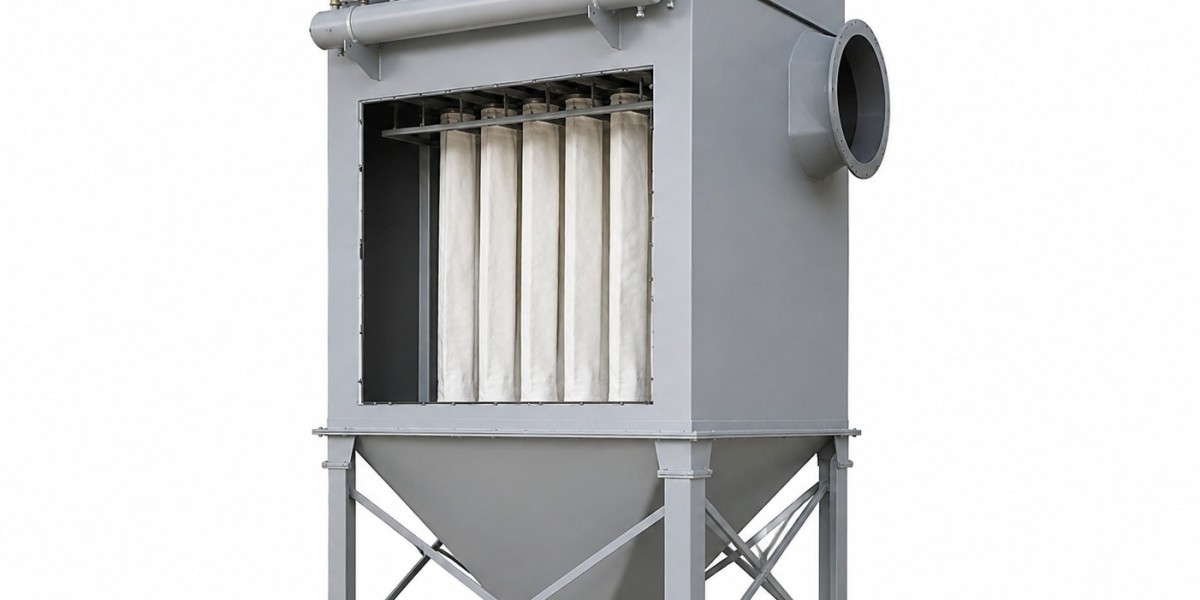

A dust collection system may look straightforward from the outside: dusty air enters, filtration takes place, and cleaner air leaves the equipment. But inside an industrial plant, filtration performance is influenced by much more than the filter itself. Dust composition, temperature, moisture, airflow, pressure drop, cleaning frequency, and process variations can all determine whether a filtration system continues to perform consistently.
This is why selecting a Bag Filter should begin with understanding the process rather than simply comparing equipment dimensions or quoted airflow. A filter that works well under one set of operating conditions may behave very differently when the dust load, temperature, humidity, or production schedule changes.
GPT-INDIA, Green Planet Technologies, works in industrial air pollution control and ventilation applications, including fabric filtration solutions for manufacturing and process industries. Its approach to dust collection focuses on matching filtration equipment with the actual operating environment.
Dust Is Not Just Dust
One of the most important considerations in industrial filtration is the nature of the material being collected.
Different processes generate particles with different sizes, shapes, densities, temperatures, and surface characteristics. Fine powder can behave differently from fibrous material. Abrasive dust can create wear concerns, while sticky particles may interfere with filter cleaning. Hygroscopic dust can absorb moisture and potentially create filtration problems.
The same airflow volume can therefore require completely different filtration arrangements depending on the material being handled.
Before selecting a Pulse jet Bag filter, engineers generally need to understand what the dust is, how much is generated, whether the material is abrasive or sticky, its approximate particle-size distribution, and whether temperature or moisture is present in the air stream.
This process-first approach helps avoid situations where a technically capable filter is installed but struggles because the operating conditions were not properly considered.
How a Pulse Jet Bag Filter Maintains Filtration
A Pulse jet Bag filter uses fabric filter elements to separate particulate from an air stream. Dust accumulates on the filter surface while cleaned air passes through the filter media.
As dust builds up, the resistance across the filter increases. The system therefore needs a cleaning mechanism to remove accumulated material and maintain an acceptable operating pressure drop.
In pulse-jet systems, compressed air is released in short pulses through the cleaning arrangement. The resulting pressure wave causes the filter bags to flex and release accumulated dust, allowing it to fall toward the collection hopper.
The cleaning sequence can be controlled automatically according to the equipment design and operating requirements.
The objective is not to clean the bags continuously. Excessive cleaning can unnecessarily stress filter media, while insufficient cleaning can allow pressure drop to rise. A properly adjusted cleaning cycle aims to maintain filtration performance while supporting reasonable filter life.
Why Pressure Drop Deserves Attention
Pressure drop is one of the most useful indicators of how a filtration system is operating.
As dust accumulates on the filter media, resistance normally increases. The cleaning system then removes accumulated dust and helps bring the resistance back toward an acceptable operating range.
If pressure drop remains unusually high, several factors may need investigation. The dust loading may have changed. Filter bags may be blocked. Cleaning pulses may not be functioning correctly. Moisture may be affecting the dust cake. The filtration area may be inadequate for the actual operating conditions.
On the other hand, an unexpectedly low pressure drop can also deserve investigation. Damaged filter bags, poor sealing, or bypass leakage can sometimes cause the system to show unusual operating behaviour.
Monitoring pressure therefore provides useful information about the condition of the entire filtration process rather than simply the filter bags themselves.
Filtration Area Must Match the Airflow
A filtration system needs enough effective filter area to handle the required airflow under the expected dust load.
This relationship is often discussed using air-to-cloth ratio. The appropriate value depends on the application and characteristics of the dust.
If too much air is forced through too little filtration area, filtration velocity can become excessive. This can contribute to higher pressure drop, increased cleaning demand, and potentially reduced filter service life.
Increasing filtration area without considering other system factors is not automatically the solution either. The overall design must account for dust properties, cleaning method, compartment arrangement, airflow distribution, and operating conditions.
This is one reason experienced Bag filter manufacturers evaluate the process before finalizing the equipment configuration.
Filter Media Selection Is a Process Decision
The filter bag is the component directly exposed to the dust stream, so its material can significantly influence performance.
Different synthetic and engineered filtration media have different temperature resistance, chemical compatibility, permeability, mechanical strength, and cleaning characteristics.
A filter suitable for a relatively cool, dry application may not be appropriate for a process involving elevated temperatures or chemically aggressive gases.
Moisture also deserves attention. When dust becomes sticky or damp, it may become difficult to remove from the filter surface. In some applications, condensation can create serious operating problems.
Therefore, Filter bags should be selected according to the actual process environment instead of being treated as interchangeable consumables.
What Happens When the Dust Load Changes?
Industrial production rarely remains perfectly constant.
A plant may operate at partial capacity during one shift and at maximum production during another. Raw materials can change. A new machine may be connected to the extraction system. Seasonal humidity can alter the behaviour of certain dusts.
These variations can affect the filtration system.
For example, a collector designed around an average dust load may experience significantly different operating conditions during peak production. If the system has insufficient filtration area or cleaning capacity, pressure drop can increase and extraction performance may change.
This makes operating flexibility an important consideration during system design.
Hopper and Dust Discharge Are Part of Filtration
Filtration does not end when particles leave the filter surface.
Released dust needs to move through the hopper and into the collection or discharge arrangement. Poor hopper geometry, excessive dust accumulation, or an unsuitable discharge system can interfere with the operation of the collector.
Rotary air locks, screw conveyors, collection bins, or other discharge arrangements may be used depending on the application.
The discharge system must also be considered in relation to the dust characteristics. Fine powder, heavy particulate, fibrous material, and sticky dust can behave differently during collection.
A filtration system can therefore experience problems even when the filter bags and pulse-cleaning system are functioning correctly.
Why Airflow Distribution Inside the Collector Matters
Uniform airflow is important for consistent filtration.
If dusty air enters a collector unevenly, some filter areas may receive a disproportionately high dust load while others remain comparatively underutilized.
The inlet arrangement, internal baffles, compartment configuration, and gas-flow path can influence how air is distributed.
Good internal airflow management can reduce unnecessary loading on individual filter sections and support more consistent operating conditions.
This is one of the engineering details that may not be obvious when comparing equipment from photographs or basic specification sheets.
Temperature and Condensation Can Create Hidden Problems
Temperature is another operating variable that should be considered early.
Filter media have defined temperature limitations, and the actual gas temperature can vary considerably during industrial production.
More importantly, operating too close to the dew point can create condensation. Moisture combined with certain dust types may result in sticky deposits on the filter bags, hopper, or ductwork.
Once deposits become established, cleaning may become increasingly difficult.
Temperature monitoring, suitable insulation where required, appropriate material selection, and process control can therefore contribute to more reliable filtration.
Maintenance Starts Before the Filter Bags Fail
Waiting for visible failure is not an effective maintenance strategy for industrial filtration.
Changes in pressure drop, cleaning-air consumption, airflow, emissions, fan behaviour, and dust accumulation can provide early indications of developing problems.
Filter bags should be inspected according to the operating environment and maintenance schedule. Seals, cages, pulse valves, solenoid components, controllers, hoppers, discharge equipment, and access doors also require attention.
A small issue in the cleaning system can eventually affect the condition of the filter bags. Similarly, a leaking access door can introduce false air and change system performance.
The entire collector should therefore be treated as an integrated system.
What to Ask Bag Filter Suppliers Before Ordering
When comparing Bag filter suppliers, industries should look beyond basic capacity and price.
A useful technical discussion should cover the dust characteristics, airflow, operating temperature, moisture conditions, filtration area, filter media, cleaning arrangement, pressure-drop expectations, dust discharge method, fan requirements, and maintenance access.
The supplier should also be able to explain how the proposed design responds to variations in the process.
This becomes particularly important for plants expecting future expansion. A collector selected only for today's operating conditions may not remain suitable if production capacity increases substantially.
Choosing Bag Filter Manufacturers for Long-Term Operation
The role of the manufacturer extends beyond fabrication.
Experienced Bag filter manufacturers should be able to translate process information into equipment design and explain why specific filtration media, cleaning arrangements, dimensions, and operating parameters are being proposed.
Manufacturing quality also matters because the collector contains multiple components that need to work together under continuous industrial operation.
Welding quality, sealing, access arrangements, structural construction, filter installation, hopper design, and component integration can all affect practical reliability.
For the buyer, this means evaluating the complete engineering approach rather than selecting equipment only from a catalogue photograph.
The Importance of Reliable Filter Bags Suppliers
Filter replacement is a normal part of long-term dust collector operation.
However, replacement bags should match the original application requirements. Differences in media, dimensions, finish, permeability, stitching, or construction can change filtration behaviour.
Reliable Filter bags suppliers should therefore be able to identify the correct replacement specification rather than supplying a visually similar product.
Keeping accurate records of bag dimensions, media type, installation date, operating conditions, and replacement history can also make future maintenance more predictable.
Working With Filter Bags Manufacturers
For specialized applications, direct technical communication with Filter bags manufacturers can be valuable. Some industrial processes have unusual temperature conditions, dust properties, dimensions, or cleaning requirements that make standard filter specifications unsuitable.
The manufacturer should be given enough process information to determine whether the selected media and construction are compatible with the application.
This is particularly important where filter bags represent a significant portion of the collector's ongoing maintenance cost.
GPT-INDIA and Practical Industrial Filtration
GPT-INDIA, Green Planet Technologies, develops industrial air pollution control and filtration solutions for different manufacturing and process environments. Its product range includes fabric filtration systems designed around industrial dust collection requirements.
For industries evaluating a new collector, upgrading an existing installation, or planning replacement Filter bags, the engineering discussion should begin with the process and expected operating conditions.
GPT-INDIA operates from 59/2/1, Site 4, Industrial Area, Sahibabad, Distt. Ghaziabad–201010, Uttar Pradesh, India, with manufacturing operations in New Delhi and Sahibabad. For enquiries, contact +91-9773500660 or info@gpt-india.com.
Frequently Asked Questions
What factors affect Bag Filter performance?
Performance can be influenced by airflow, dust concentration, particle characteristics, filtration area, filter-media selection, temperature, moisture, pressure drop, cleaning settings, and dust discharge conditions.
How does a Pulse jet Bag filter clean its filter bags?
Compressed-air pulses create a short cleaning action that dislodges accumulated dust from the filter bags. The released material falls toward the collection hopper.
Why does pressure drop increase in a bag filtration system?
Pressure drop can rise as dust accumulates on the filter surface. It can also increase because of blocked or unsuitable filter media, inadequate cleaning, excessive dust loading, moisture-related deposits, or insufficient filtration area.
How often should Filter bags be replaced?
There is no single replacement interval for every application. Service life depends on dust characteristics, temperature, cleaning intensity, filtration velocity, media selection, and operating conditions. Condition-based inspection is more useful than relying only on a fixed calendar interval.
What should I discuss with Bag filter suppliers?
Discuss the dust type, airflow, dust loading, operating temperature, moisture, filtration area, filter media, cleaning method, pressure drop, dust discharge arrangement, and expected production conditions.
Are Filter bags interchangeable between different collectors?
Not necessarily. Filter bags need to match the collector's dimensions, media requirements, installation arrangement, operating temperature, dust characteristics, and cleaning system.
Conclusion
Industrial fabric filtration performs best when the equipment is designed around the process rather than selected from airflow capacity alone. Dust properties, filtration velocity, cleaning behaviour, pressure drop, temperature, moisture, and discharge arrangements all influence how a collector behaves after installation.
For this reason, selecting the right equipment and maintaining the correct filter media are equally important parts of long-term dust-control planning. A well-matched filtration system can make operating conditions more predictable, simplify maintenance planning, and help maintain consistent extraction performance as production changes.
GPT-INDIA approaches industrial dust filtration from this process-oriented perspective, helping industries evaluate equipment and Filter bags according to their actual operating requirements rather than relying on generic specifications.