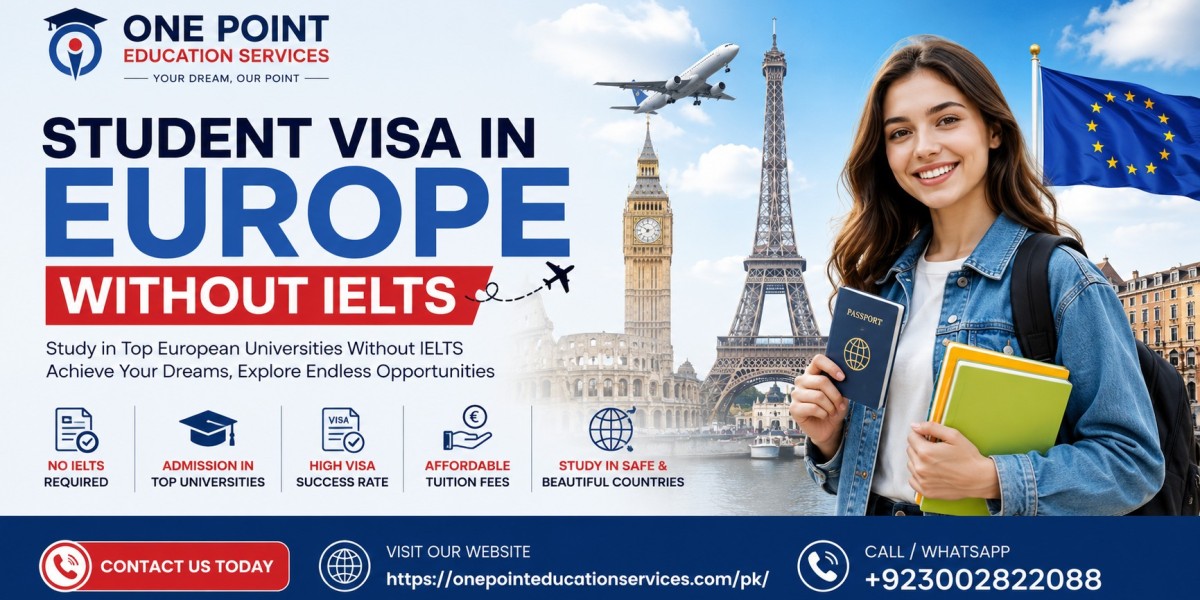

Student Visa Without IELTS in Europe: Step-by-Step Application Guide in 2027
Studying in Europe is a popular goal for students from Lahore and across Pakistan. European universities offer a wide range of bachelor's, master's, and other higher-education programs, along with opportunities to experience international education and build a global career.
For many Pakistani students, one of the biggest concerns during the study-abroad process is the IELTS examination. Preparing for IELTS can require significant time, planning, and preparation. The good news is that some European universities and study destinations may accept alternative forms of English-language proof, depending on the institution, course, and applicant's previous education.
This has increased interest in Student Visa in Europe without IELTS options.
However, it is important to understand one key point: being admitted to a university without IELTS does not automatically mean that every student can obtain a visa without providing any evidence of English proficiency. University admission requirements and visa requirements are separate matters.
In this guide, One Point Education Services explains the general step-by-step process for Pakistani students in Lahore who want to explore studying in Europe without IELTS in 2027.
What Does “Student Visa in Europe Without IELTS” Mean?
A Student Visa in Europe without IELTS generally refers to a study route where a university accepts an applicant without requiring an IELTS score as its standard English-language admission requirement.
Depending on the university and program, an institution may accept alternatives such as:
Medium of Instruction (MOI) certificate
Previous education completed in English
University-specific English assessment
Online English interview
Other recognized English-language tests
Internal language assessment
Proof of English proficiency accepted by the university
The exact option depends on the university, degree program, country, and applicant's academic background.
Students should therefore avoid assuming that “without IELTS” means no English-language requirement at all.
Can Pakistani Students Study in Europe Without IELTS in 2027?
Yes, some universities and programs may allow international students to apply without IELTS, but eligibility varies.
For a student from Lahore, the first step should be identifying universities that specifically accept an alternative to IELTS for the selected course.
For example, a university may consider your previous qualification if it was taught in English and may request an MOI certificate. Another institution may conduct its own interview or assessment.
At the same time, the relevant immigration authority or embassy may have additional requirements for a student residence permit or visa.
That is why students should evaluate both:
University admission requirements
Student visa or residence permit requirements
Both need to be satisfied before travelling to Europe.
Step-by-Step Application Process for a Student Visa Without IELTS
Step 1: Choose Your Study Destination
The first step is deciding which European country is suitable for your academic plans.
Consider factors such as:
Available courses
Tuition fees
Living expenses
University requirements
English-taught programs
Scholarship opportunities
Visa or residence permit requirements
Accommodation
Post-study opportunities
Your academic qualifications
Do not select a country simply because someone claims that visas are “easy” without IELTS. Immigration policies and university requirements can change, and individual applications are assessed according to the applicable rules.
For students in Lahore, it can be useful to create a shortlist of countries and universities before beginning the application process.
Step 2: Find Universities That Accept Alternatives to IELTS
Once you have selected potential study destinations, research universities offering your desired program.
Look carefully at the English-language requirements on the university's official website.
Some institutions may accept an MOI certificate, while others may require an English test or another form of proof.
You should check:
Minimum academic percentage or CGPA
Required degree
English-language requirement
Accepted alternatives to IELTS
Application deadlines
Tuition fees
Application fee
Required documents
Financial requirements
Program-specific conditions
Students should always confirm the requirements for their exact course rather than relying only on general information about a country.
Step 3: Check Whether Your Previous Education Qualifies
For Pakistani students, previous education can sometimes be relevant when a university considers an alternative to IELTS.
If your previous qualification was taught in English, the university may accept a Medium of Instruction (MOI) certificate or another form of evidence.
However, acceptance is not automatic.
An MOI certificate accepted by one university may not necessarily be accepted by another. Some universities may still require IELTS, another English test, or an interview.
Before applying, confirm directly with the institution whether your academic background satisfies its English-language requirements.
Step 4: Prepare Your Academic Documents
After identifying suitable universities, prepare your academic documents.
Depending on the university and level of study, you may need:
Passport
Matriculation certificate
Intermediate certificate
Bachelor's degree
Master's degree, if applicable
Academic transcripts
MOI certificate, where accepted
CV
Statement of Purpose
Recommendation letters
Passport-size photographs
Employment documents, if applicable
Other documents requested by the university
Make sure your documents are clear, complete, and consistent.
If a university requests certified translations, notarization, legalization, or apostille-related documentation, follow its specific instructions.
Step 5: Apply to the University
After preparing your documents, submit your application according to the university's procedure.
Some universities have online application portals, while others may use different application systems.
During the application process, clearly provide accurate information about your education and English-language background.
If the university asks whether you have IELTS, do not provide misleading information. If you are applying under an alternative English-language pathway, submit the evidence requested by the university.
An inaccurate document or false statement can create serious problems during admission or the visa process.
Step 6: Receive Your Admission or Offer Letter
If your application is successful, the university may issue an offer letter or admission confirmation.
Read it carefully.
Check:
Your name and passport details
Program name
Start date
Duration of study
Tuition fee
Conditions of admission
Deposit requirements
Deadline for accepting the offer
If your admission is conditional, complete all conditions before moving to the next stage.
Most importantly, confirm that your university admission specifically reflects the English-language requirement applicable to your case.
Step 7: Pay Tuition Fees or Required Deposit
Depending on the university and country, you may need to pay a tuition deposit or other required amount before receiving final enrollment documents.
Always make payments through the official payment method provided by the university.
Keep copies of:
Payment receipt
Bank transaction evidence
University invoice
Enrollment confirmation
Correspondence with the institution
These documents may be useful during the visa or residence-permit process.
Step 8: Prepare Your Financial Documents
Financial evidence is an important part of many European student visa or residence permit applications.
The exact amount and acceptable evidence vary by country.
Students may be asked to demonstrate that they can cover expenses such as:
Tuition fees
Accommodation
Food and daily living expenses
Transportation
Insurance
Other necessary costs
Depending on the destination, acceptable financial evidence may include bank statements, scholarship documentation, sponsorship evidence, blocked-account arrangements, or other officially accepted proof.
Pakistani applicants should prepare financial documents carefully and ensure that the information is genuine and verifiable.
Avoid unexplained transactions or artificial arrangements intended only to show funds.
Step 9: Arrange Accommodation
Many students need to provide evidence of accommodation as part of their visa or residence application.
Possible arrangements can include:
University accommodation
Student residence
Private rental
Other accommodation accepted by the relevant authorities
Keep your accommodation confirmation or rental documentation safely.
The requirements differ between European countries, so check the official immigration instructions for your destination.
Step 10: Obtain Health Insurance
Health insurance requirements vary depending on the European country and the type of student residence permit or visa.
You may need insurance covering the required period and meeting specific conditions.
Before purchasing a policy, verify the requirements of the destination country's immigration authority or embassy.
Keep the original policy and supporting documents with your visa application documents.
Step 11: Submit Your Student Visa or Residence Application
After receiving the necessary university documents, prepare your immigration application.
Depending on the destination, you may apply for a student visa, long-stay visa, residence permit, or another student immigration category.
Commonly requested documents can include:
Valid passport
University admission letter
Proof of tuition payment, where applicable
Financial evidence
Accommodation evidence
Health insurance
Academic documents
Passport photographs
Visa application form
Proof of application fee payment
English-language evidence, where required
Other country-specific documents
The absence of IELTS does not automatically remove other visa requirements.
Step 12: Attend Your Visa Appointment or Interview
Some applicants may be required to attend an appointment or interview.
During an interview, you may be asked about:
Why you selected the university
Why you selected the course
Your academic background
Your future plans
How your education will be funded
Where you will live
Why you want to study in the selected country
Your previous education
Your English-language ability
Answer honestly and confidently.
Your responses should be consistent with your submitted documents and educational plans.
If you are applying without IELTS through an accepted alternative, be prepared to explain how you meet the university's English-language requirement.
Documents Required for Student Visa in Europe Without IELTS
Document requirements differ between European countries. However, Pakistani students may commonly need a combination of the following:
Academic Documents
Educational certificates
Academic transcripts
Degree certificates
MOI certificate, if accepted
Admission letter
Other academic documents requested by the university
Personal Documents
Valid passport
Passport photographs
National identity documents, where required
Completed application forms
Financial Documents
Bank statements
Sponsorship documents
Scholarship confirmation
Tuition payment evidence
Other financial proof required by the destination
Supporting Documents
Accommodation confirmation
Health insurance
Statement of Purpose
CV
Travel-related documents, where applicable
Visa appointment confirmation
Additional documents requested by the embassy or immigration authority
Always use the current official checklist for your specific destination.
Is MOI Enough for a Student Visa Without IELTS?
An MOI certificate can be useful if the university accepts it as proof of English-medium education.
However, students should distinguish between university acceptance and immigration requirements.
For example, a university may accept an MOI certificate and issue admission without IELTS. The relevant immigration authority may still have its own rules about language evidence.
Therefore, before submitting a visa application, confirm:
Whether the university accepts your MOI.
Whether your specific program qualifies for the IELTS alternative.
Whether the destination's immigration authority accepts the same evidence.
Whether an interview or additional English assessment may be required.
This can help prevent misunderstandings during the application process.
Benefits of Applying Without IELTS
For eligible students, an IELTS-free admission route can have several practical advantages.
Less Test Preparation
Students who already have an English-medium academic background may be able to use existing documentation instead of preparing for a separate language examination.
Potentially Faster Application Preparation
If the university accepts an alternative form of English proof, students may be able to proceed with their application without waiting for an IELTS test date and result.
More Flexibility
Alternative English-language pathways can give students additional options when selecting universities and programs.
However, these benefits depend on the individual university and immigration requirements.
Important Things Pakistani Students Should Know
Students in Lahore should be careful when evaluating claims about Student Visa in Europe without IELTS.
No legitimate education consultant can guarantee a visa.
Visa decisions are made by the relevant authorities based on the applicant's circumstances and the applicable immigration rules.
Be cautious about anyone who promises:
Guaranteed visa approval
Guaranteed admission
Fake documents
Guaranteed jobs
Guaranteed permanent residence
Guaranteed scholarships
A visa simply because IELTS is not required
A genuine application should be based on authentic academic documents, transparent financial evidence, a legitimate university offer, and compliance with immigration rules.
How One Point Education Services Can Help Students in Lahore
For students based in Lahore, navigating European university and visa requirements can be complicated, particularly when comparing universities that offer alternatives to IELTS.
One Point Education Services can assist students in understanding the general study-abroad process, identifying suitable university options based on their academic profile, organizing application documents, and preparing for the next stages of the admission process.
Students should provide accurate information about their academic qualifications, study gap, financial circumstances, intended field of study, and previous English-medium education.
The more accurate your information is, the easier it is to identify programs for which you may meet the published requirements.
Final Checklist for Students Applying in 2027
Before submitting your application, review the following checklist:
Choose your preferred European country.
Select an appropriate degree program.
Check the university's current IELTS requirements.
Confirm whether MOI or another alternative is accepted.
Prepare academic documents.
Prepare a valid passport.
Apply to the university.
Receive your admission letter.
Pay required tuition or deposit.
Prepare financial evidence.
Arrange accommodation.
Obtain the required health insurance.
Check the current student visa or residence permit requirements.
Prepare for a possible interview.
Submit genuine and complete documents.
Follow the official immigration instructions.
Remember that requirements can change before 2027. Always verify the latest requirements with the selected university and the relevant European immigration authority before submitting an application.
Conclusion
A Student Visa in Europe without IELTS can be possible for eligible international students when a university accepts an alternative method of demonstrating English proficiency. For Pakistani students in Lahore, the process starts with choosing the right university and course, checking whether IELTS alternatives are accepted, preparing authentic documents, obtaining admission, demonstrating sufficient finances, and meeting the destination country's immigration requirements.
The most important point is to treat “without IELTS” as an alternative admission or language-proof pathway, not as a guarantee that no English evidence will be required for immigration.
If you are planning to study in Europe in 2027, start preparing early. University deadlines, document requirements, financial requirements, and visa procedures can vary considerably between countries and institutions.
For guidance on European study options, university applications, and the student visa process, students in Lahore can contact One Point Education Services for assistance with planning their study-abroad journey.
FAQs About Student Visa in Europe Without IELTS
1. Can I get a Student Visa in Europe without IELTS?
In some cases, yes. Certain universities may accept alternatives to IELTS, such as an MOI certificate or another approved form of English proficiency. However, admission and visa requirements are separate, so students must check the immigration rules of their selected country.
2. Can Pakistani students study in Europe without IELTS?
Some Pakistani students may qualify for university programs that do not require IELTS. Eligibility depends on the university, program, previous education, and accepted English-language evidence.
3. Is MOI accepted instead of IELTS in Europe?
Some universities accept a Medium of Instruction certificate, but acceptance is not universal. Students should confirm whether their selected university and program accept MOI before applying.
4. Does an admission without IELTS guarantee a student visa?
No. A university admission decision does not guarantee visa approval. Applicants must separately satisfy the relevant immigration requirements.
5. What documents are required for a European student visa?
Requirements vary by country. Common documents may include a passport, admission letter, financial evidence, accommodation information, health insurance, academic documents, application forms, and other supporting documents.
6. Can I apply for a European student visa from Lahore?
Pakistani students generally need to follow the application procedure specified by the embassy, consulate, visa center, or immigration authority responsible for their chosen European destination.
7. Can I use an English-medium degree instead of IELTS?
Some universities may accept evidence that your previous education was conducted in English. Whether this is sufficient depends on the institution and program.
8. Do I need to show bank statements for a European student visa?
Many European destinations require students to demonstrate sufficient financial resources, although the exact amount and acceptable evidence differ by country.
9. What should I do first if I want to study in Europe without IELTS?
Start by selecting your desired field and destination, then identify universities that explicitly accept an alternative to IELTS. Check the university's current requirements before preparing your application.
10. How can One Point Education Services help students from Lahore?
One Point Education Services can help students understand university options, application requirements, document preparation, and the general study-abroad process. Students should verify final admission and immigration requirements with the relevant university and authorities.