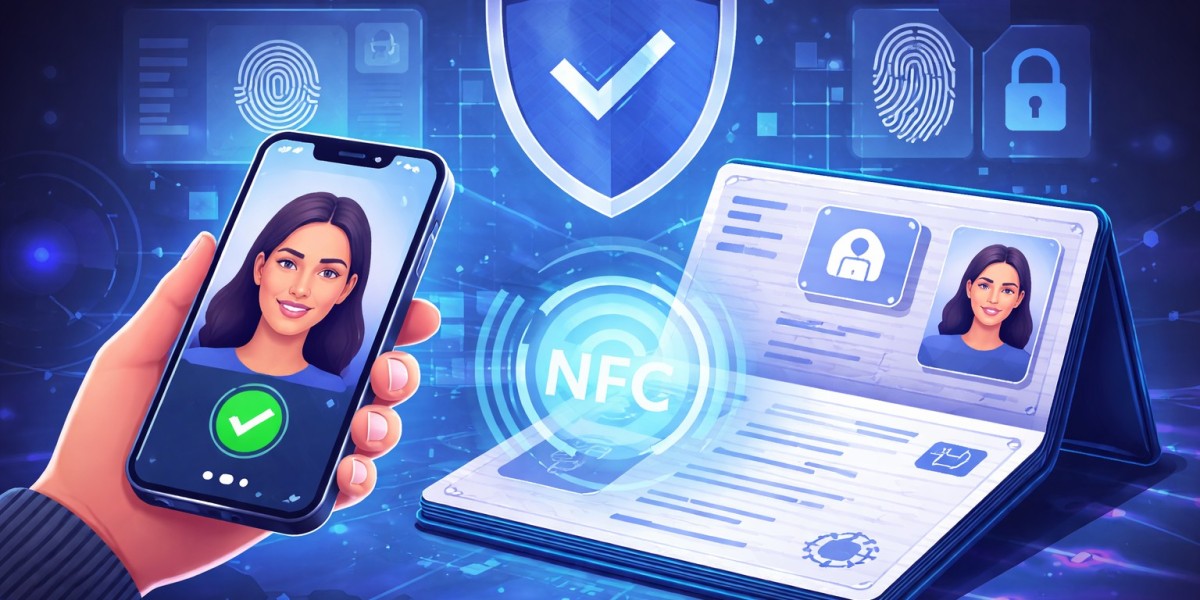

As digital services continue to grow, businesses need reliable ways to verify users remotely. NFC identity verification and face verification are two technologies helping organizations build faster and more secure digital onboarding processes. When used together, they can add multiple layers of identity validation while keeping the user experience simple.
What Is NFC Identity Verification?
NFC identity verification uses Near Field Communication (NFC) technology to read information stored in compatible identity documents, such as electronic passports and NFC-enabled identity cards. A smartphone with NFC capability can communicate with the document and retrieve relevant chip data for verification.
The process can help businesses validate document information and identify signs of document manipulation. Since the information is obtained directly from the embedded chip, NFC-based verification can provide an additional layer of confidence compared with relying only on document images.
NFC identity verification can be useful for digital onboarding, banking, financial services, travel-related platforms, telecom services, and other applications where secure identity verification is required.
What Is Face Verification?
Face verification is a biometric process that compares a person's facial image with a trusted reference image. During digital onboarding, a user may capture a selfie, which can then be compared with the photograph associated with their identity document.
Modern face verification systems can analyze facial characteristics to determine whether the submitted face corresponds to the identity being verified. Additional technologies such as face liveness detection can also help determine whether the interaction involves a real person rather than a photograph, video, or other presentation attack.
Combining NFC Identity Verification and Face Verification
Using NFC identity verification together with face verification creates a multi-layered identity verification process. NFC technology can validate information from an electronic identity document, while face verification can help establish that the person completing the verification matches the document holder.
A typical workflow may include:
- Capturing identity document details
- Reading NFC chip information from a compatible document
- Checking document data for consistency
- Capturing a user's facial image
- Comparing the face with the document photograph
- Applying liveness checks where required
- Generating a verification result
This approach can help organizations reduce manual verification and create a smoother remote onboarding experience.
Applications Across Digital Services
NFC identity verification and face verification can support various industries. Banks and fintech companies can use these technologies during customer onboarding, while telecom providers can integrate them into remote SIM registration and account verification workflows. Travel, insurance, healthcare, recruitment, and online marketplaces can also benefit from automated identity verification.
Conclusion
The combination of NFC identity verification and face verification provides organizations with a technology-driven approach to digital identity validation. By combining document-based verification with biometric face matching, businesses can strengthen their onboarding workflows while reducing dependence on manual checks. As digital transactions continue to expand, NFC and facial biometrics can play an important role in creating secure and convenient identity verification experiences.