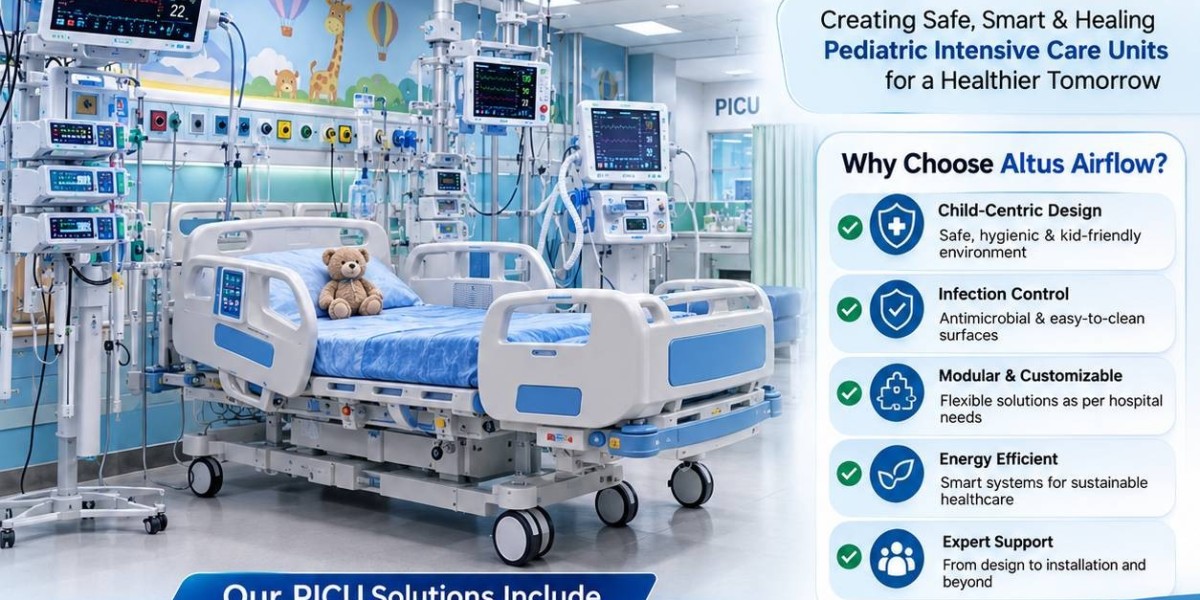

INTRODUCTION
A Pediatric Intensive Care Unit requires specialized planning because critically ill infants and children need an environment designed around their clinical, safety, and monitoring requirements. Selecting PICU Manufacturers In India should therefore involve evaluating much more than construction or individual equipment. Hospitals should assess design capabilities, space planning, medical infrastructure, equipment integration, ventilation, infection-control provisions, staff workflow, maintenance, and future adaptability. The 2020 Indian consensus guidelines for PICUs specifically address unit design, equipment, organization, staffing, and support services, providing a useful reference when planning or modifying a pediatric intensive-care facility.
Evaluate the Overall PICU Design
A quality PICU project begins with a layout that supports pediatric critical-care activities. The unit should provide appropriate patient-care areas, clear movement routes, adequate access to the head of each bed, and sufficient room for emergency procedures and portable equipment.
Indian PICU guidance recommends that the unit be dedicated to infants and children and separate from neonatal and adult ICUs. It also recommends convenient access to important hospital departments such as emergency services, operation theatres, laboratories, and radiology.
Check Bedside Space and Accessibility
Adequate space around every patient bed is important for procedures, monitoring, equipment placement, and emergency intervention. The design should allow staff to reach the child quickly without equipment, furniture, or infrastructure becoming an obstruction.
The Indian guidelines specify space recommendations for ward-type beds and cubicles and emphasize sufficient room for procedures and access to portable X-ray, ultrasound, ECG, and other equipment.
Review Equipment Integration
A modern pediatric intensive-care facility may include ventilators, multiparameter monitors, infusion pumps, warmers, high-flow systems, emergency equipment, and other specialized technologies. Equipment planning should account for pediatric use, accessibility, compatibility, maintenance, and future upgrades.
The PICU consensus guidelines recommend considering accuracy, adaptability for pediatric patients, ease of use, troubleshooting, maintenance requirements, and biomedical support when selecting equipment.
Examine Medical Gas and Electrical Infrastructure
Medical gases and electrical services are fundamental components of critical-care infrastructure. Oxygen, air, suction, electrical outlets, emergency power, and other bedside services should be positioned according to clinical requirements and equipment loads.
PICU guidance recommends multiple oxygen, air, suction, and electrical outlets at each bed so that essential equipment can operate without excessive dependence on extension arrangements.
Consider Ventilation and Environmental Control
Ventilation should be incorporated into the facility design from the beginning. Temperature, humidity, air movement, filtration, and air-quality considerations can influence the suitability of the clinical environment.
General Indian critical-care planning guidance recommends controlled environmental conditions and appropriate ventilation strategies as part of ICU design.
Prioritize Infection-Control Features
Children receiving intensive care can require prolonged monitoring and invasive procedures, making infection prevention an important consideration. Surfaces, finishes, equipment positioning, hand-hygiene access, cleaning routes, and utility areas should support effective infection-control practices.
PICU guidance recommends smooth, non-porous, easy-to-clean walls, ceilings, and floors, with edges designed to reduce dust accumulation.
Assess Central Monitoring and Staff Workflow
A well-planned central station can improve visibility and coordination. It should provide adequate room for staff functions, patient records, computers, monitoring systems, communication, and documentation.
The PICU guidelines recommend that the central station provide visibility to patient areas and adequate space for staff, computers, printers, and central monitoring.
Review Emergency and Safety Provisions
Emergency access should be considered throughout the layout. Each bed should allow convenient airway access, while emergency equipment and crash carts should be positioned for rapid retrieval.
The guidelines identify appropriately stocked crash carts as mandatory for the specified PICU levels and emphasize regular checking and documentation of emergency equipment.
Look at Family and Counselling Areas
Pediatric critical care involves communication with parents and caregivers as an important part of hospital operations. Dedicated counselling and family areas can provide a more appropriate setting for discussions while supporting privacy and organized visitation.
Indian PICU guidance recommends counselling facilities close to the unit and identifies family waiting areas and related support spaces as useful components of PICU planning.
Examine Installation and Commissioning
Hospitals should not evaluate a project only by its drawings or proposed specifications. Installation quality, testing, commissioning, documentation, and handover are equally important.
The provider should have a structured process for verifying medical gas systems, electrical infrastructure, ventilation, monitoring connections, safety features, and other installed components before the unit becomes operational.
Consider Maintenance and Technical Support
Long-term reliability depends on proper maintenance. Equipment and infrastructure should remain accessible for inspection, servicing, calibration, cleaning, and replacement.
Critical-care planning guidance emphasizes maintenance policies, regular servicing, calibration, and responsible equipment management.
Assess Future Adaptability
A PICU should not be designed only around today's equipment list. Technology, patient volumes, clinical services, and hospital requirements can change over time.
Flexible infrastructure and adequate service capacity can make future modifications easier. Hospitals should therefore discuss potential expansion, additional equipment, technology upgrades, and changes in clinical workflows during the initial planning stage.
Compare Complete Project Capabilities
When reviewing potential providers, hospitals can examine whether they understand the complete relationship between architecture, medical infrastructure, environmental systems, equipment, safety, and clinical workflow. A provider capable of coordinating these elements can help reduce conflicts between different project components.
The objective should be to select a solution that aligns with the hospital's clinical requirements, available space, operational model, and applicable guidelines rather than evaluating a facility on a single feature.
Conclusion
Finding suitable PICU Manufacturers In India requires a comprehensive assessment of design, patient-care space, medical gases, electrical systems, equipment integration, ventilation, infection control, emergency access, staff workflow, maintenance, and future flexibility. Hospitals should review technical capabilities and project documentation carefully while involving clinical, biomedical, engineering, and infection-control teams in the evaluation process. A well-coordinated approach can support the development of a pediatric intensive-care environment that is functional, maintainable, and appropriate for specialized pediatric care.
FAQs
1. What should hospitals consider when evaluating a PICU facility provider?
Hospitals should review design expertise, space planning, infrastructure integration, equipment compatibility, ventilation, infection-control provisions, installation, commissioning, maintenance, and future expansion capabilities.
2. Why is pediatric-specific design important in a PICU?
Children have different clinical and equipment requirements from adults. Indian PICU guidelines therefore address pediatric-specific design, equipment selection, monitoring, staffing, and support services.
3. How important is equipment integration in PICU planning?
It is highly important because monitors, ventilators, infusion pumps, emergency equipment, and other devices need suitable space and accessible connections without obstructing clinical workflows.
4. What infrastructure should be planned at each PICU bed?
Depending on the level and clinical requirements, planning can include oxygen, medical air, suction, electrical outlets, emergency power, monitoring connections, and other bedside services.
5. Why should maintenance be considered during PICU design?
Maintenance access allows systems and equipment to be inspected, serviced, calibrated, and repaired more efficiently. Planning for maintenance from the beginning can help support long-term facility reliability.
Read Our Previous Blog-----------> Top NICU Manufacturers In India: What Makes Them Reliable?