
Introduction
Finding potential customers is only one part of building a successful B2B sales pipeline. Businesses also need to identify the right companies, reach relevant decision-makers, and understand whether a prospect fits their products or services. Without reliable information, sales teams may spend valuable time contacting unsuitable businesses or working with outdated contact details.
A business leads provider helps organizations discover potential customers by supplying company information and relevant business contact details. When lead data is combined with company intelligence, businesses can move beyond collecting names and numbers to identify prospects based on industry, business activity, location, and decision-making roles.
For B2B companies, financial service providers, technology firms, and corporate sales teams, this approach can make prospect research more organized and targeted. The key is choosing a provider that offers useful, accurate, and relevant information to support real sales objectives.
What Is a Business Leads Provider?
A business leads provider is a service or platform that helps organizations identify prospective customers and access information needed to initiate business conversations. Depending on the provider, its database may include company names, industry classifications, registered addresses, business profiles, director details, promoter information, and available professional contact details.
Unlike general consumer lead databases, B2B lead providers focus on businesses and the people associated with them. This information helps sales and marketing teams identify organizations that match their target customer profile.
For example, a company offering accounting software to Indian manufacturers may need to identify manufacturing businesses of a particular size and connect with relevant business owners or finance professionals. A suitable business leads provider can help narrow the prospect list and reduce the effort involved in researching each company individually.
The value of a provider depends not only on the number of records available but also on their relevance, freshness, source transparency, and suitability for the intended outreach.
Why Do Businesses Need a Reliable Business Leads Provider?
1. Identify Relevant B2B Prospects
A large contact list does not automatically produce qualified opportunities. Sales teams need prospects that match their product, target industry, geography, and business requirements.
Business lead databases can help organizations filter companies according to available attributes, making it easier to create prospect lists that align with their ideal customer profile.
2. Reach Relevant Decision-Makers
B2B purchasing decisions often involve business owners, directors, promoters, procurement teams, finance managers, or other authorized stakeholders.
Access to relevant company and professional information can help sales teams understand whom they should approach. This makes outreach more focused than sending the same message to every contact within an organization.
3. Reduce Manual Prospect Research
Researching individual companies across multiple websites and directories can be time-consuming. A centralized business leads platform can simplify the process by organizing company details and related information in one place.
Sales representatives can then spend more time evaluating opportunities, preparing relevant messages, and building business relationships.
4. Support Industry-Specific Sales Campaigns
Different products serve different business segments. A logistics provider may target manufacturers and distributors, while a financial technology company may focus on businesses that need digital payment or credit solutions.
A business leads provider can help teams identify companies within specific sectors and develop campaigns suited to their business needs.
5. Improve Sales Planning
Organized lead information allows sales managers to divide prospects by industry, region, company characteristics, or priority. This supports clearer territory planning, account allocation, and campaign measurement.
However, lead data should be regularly validated. Contact availability and company information can change, so teams should not assume that every record remains current.
Key Features to Look for in a Business Leads Provider
Choosing a provider requires more than comparing database sizes. The quality and usefulness of the information should guide the decision.
Company Information and Business Profiles
Look for company names, industry classifications, registered addresses, business activity, and other relevant profile details. Such information helps sales teams determine whether a prospect is suitable before initiating contact.
Director and Promoter Information
Director and promoter details can help businesses understand company leadership and identify relevant stakeholders. This is particularly useful for organizations selling products or services to business owners and senior decision-makers.
The provider should clearly distinguish publicly available corporate information from verified professional contact information.
Search and Filtering Capabilities
Flexible filters make it easier to find prospects based on industry, location, company type, or other supported business attributes. More relevant filters can help sales teams build targeted lists instead of relying on broad, unqualified databases.
Data Quality and Update Frequency
Outdated records can lead to failed outreach and wasted sales effort. Evaluate how the provider sources, verifies, and refreshes its information. Ask whether it explains the update frequency and offers ways to report inaccurate records.
Data Export and Workflow Compatibility
Depending on the provider, teams may need to export records or integrate lead information with their existing CRM and sales processes. Check which capabilities are available before selecting a platform.
Privacy and Responsible Data Use
Business contact information should be collected and used responsibly. Organizations should review the provider's data sourcing practices, applicable privacy requirements, consent obligations, and permitted uses of contact information before launching outreach campaigns.
How to Choose the Right Business Leads Provider
The best provider is the one that supports your specific sales objectives rather than simply offering the largest database.
Step 1: Define your target audience. Identify the industries, business types, locations, and decision-making roles that matter to your sales strategy.
Step 2: Assess the available information. Check whether the provider offers the company details and contact fields your team actually needs.
Step 3: Test data relevance. Review a sample of records and evaluate their completeness, accuracy, freshness, and suitability for your target market.
Step 4: Compare search capabilities. Determine whether the platform allows you to identify prospects using meaningful business criteria.
Step 5: Review compliance and support. Understand how the data is sourced, what usage restrictions apply, and what support is available when information needs correction.
Step 6: Measure commercial outcomes. Track meaningful metrics such as qualified leads, positive responses, meetings booked, and opportunities generated. These measures provide a better assessment of value than the total number of records alone.
How Company Intelligence Strengthens B2B Lead Generation
Traditional lead generation often focuses on collecting contact details. Company intelligence adds context that helps businesses decide which prospects deserve attention.
For example, a sales team targeting Indian businesses may use company profiles, corporate records, director associations, and other available business information to understand a prospect before reaching out. This can help representatives prepare more relevant conversations and identify organizations that align with their offering.
Company intelligence can also support account prioritization. Instead of treating every prospect equally, teams can group companies according to business fit, available information, and sales potential.
For financial service providers, company information may offer additional context for understanding prospective business customers. However, sales qualification and credit assessment are different processes; lead data alone should not be treated as proof of creditworthiness.
How Credhive Supports Business Lead Research
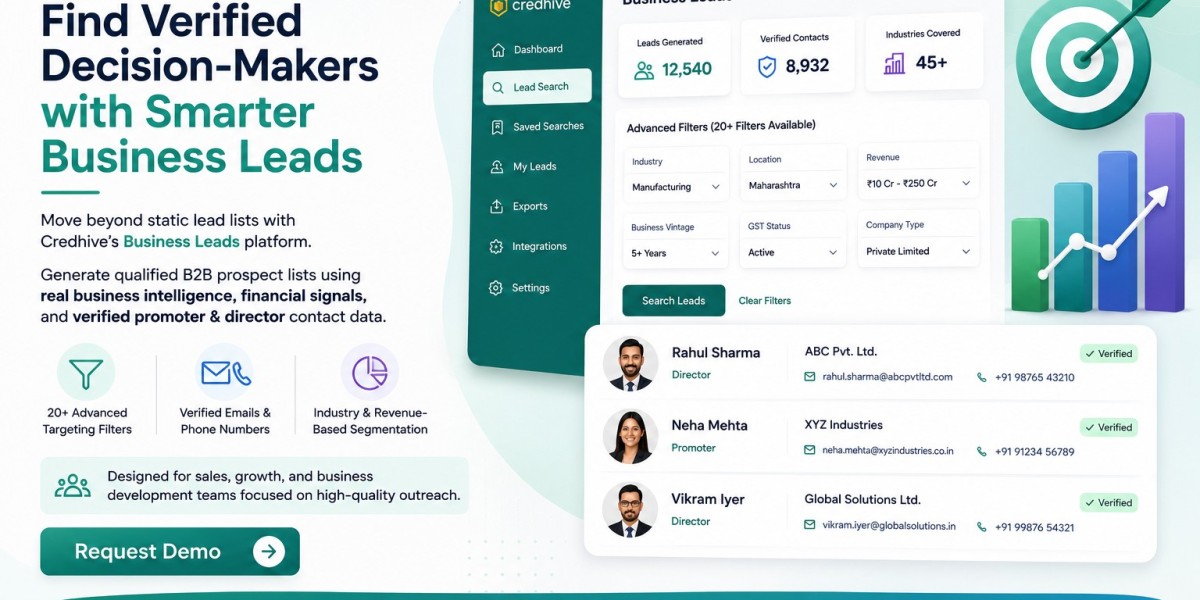
Credhive helps organizations explore company information and business intelligence to support B2B prospect research. Its Business Leads offering focuses on company information and director or promoter-related details that can help businesses identify relevant organizations and understand their corporate profiles.
By bringing useful business information together, Credhive can support teams looking to research potential customers, identify relevant business stakeholders, and organize their prospecting efforts. Companies can use this information as part of a broader sales process that includes lead qualification, personalized communication, and relationship development.
For organizations operating in India's business market, combining prospect research with company intelligence can provide a more informed starting point for B2B outreach. Businesses should still validate contact details, assess prospect relevance, and follow applicable rules when using information for marketing and sales activities.
Common Mistakes to Avoid When Using Business Lead Data
Even a comprehensive database can deliver poor results if the information is used without a clear strategy.
Prioritizing quantity over relevance: A smaller list of suitable prospects may be more valuable than thousands of poorly matched contacts.
Ignoring data freshness: Company details and professional roles can change, making regular validation important.
Using generic outreach messages: Prospects are more likely to understand the value of an offer when communication reflects their business needs.
Confusing company records with verified contacts: Corporate information does not automatically establish that a phone number or email address is current.
Failing to measure results: Teams should review lead quality and conversion outcomes to improve future prospecting.
Overlooking privacy requirements: Contact information should be used only in ways permitted by applicable laws, platform policies, and the provider's terms.
Avoiding these mistakes helps organizations use lead data as a practical sales resource rather than simply another database to maintain.
Conclusion
A reliable business leads provider can help B2B organizations discover relevant companies, identify potential decision-makers, and organize prospect research more efficiently. However, the real benefit comes from combining useful data with a clear target audience, responsible outreach, and consistent lead qualification.
Before selecting a provider, evaluate the relevance of its company records, the quality of available contact information, its search capabilities, update practices, and data-use policies. These factors are essential for building a dependable prospecting process.
With company intelligence supporting lead research, businesses can make better-informed decisions about whom to approach and how to prioritize sales opportunities. For organizations seeking a more structured approach to B2B prospect discovery, Credhive offers business information capabilities that can support company research and decision-maker identification.
Frequently Asked Questions
1. What does a business leads provider do?
A business leads provider supplies information that helps organizations identify potential business customers. Depending on the service, this may include company profiles, industry details, director information, and available professional contact details.
2. How can a business leads provider improve B2B lead generation?
It can help sales teams identify relevant companies, narrow prospect lists using available filters, research decision-makers, and reduce manual data collection. Results depend on data quality and the effectiveness of the sales process.
3. What information should a B2B lead database include?
Useful information may include company names, business addresses, industry classifications, corporate profiles, director or promoter details, and appropriately sourced professional contact information.
4. How do I evaluate the quality of a business leads provider?
Assess the accuracy, completeness, relevance, and update frequency of its records. Review sample data, understand sourcing practices, and measure how well the information supports qualified leads and actual sales opportunities.
5. Is company intelligence useful for B2B sales teams?
Yes. Company intelligence provides context about potential customers, helping sales teams research businesses, prioritize suitable accounts, and prepare more relevant outreach. It should complement, rather than replace, direct lead qualification.