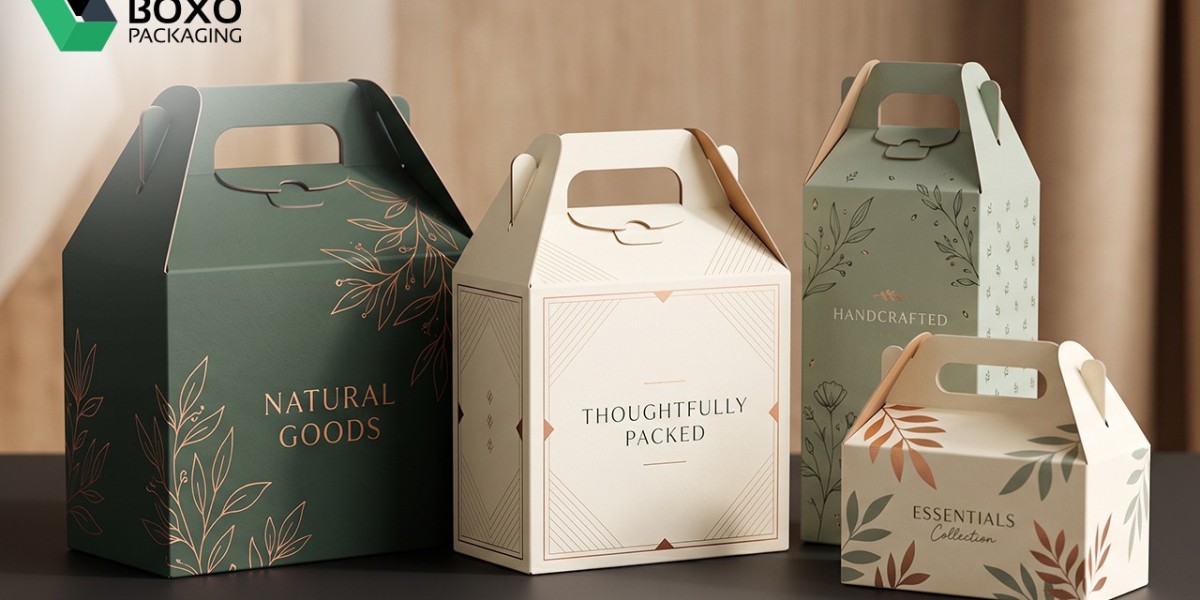

A gable carton carries its load through two places, the handle and the base, so both have to be planned together. Custom gable packaging puts the lifting point on the roof panels, which fold and lock into a grip at the top. Once the box is filled evenly, the contents stay level while someone walks with it.
Weight is the first question to answer. A box of cupcakes asks very little of the handle. A boxed lunch for six, or a set of glass jars, asks a lot more. The board around the handle opening needs enough thickness to resist tearing, and the opening should sit directly above the center of the load. If it sits off to one side, the box tips forward as soon as it's lifted.
Which Base Style Suits the Contents?
Most gable cartons close at the bottom in one of two ways. An auto-lock base ships flat and snaps into shape when the box is opened, which saves time at a busy counter. A 1-2-3 base relies on folded panels that interlock, so it takes a few more seconds to set up but doesn't depend on a glued base. Test heavier contents on both styles before deciding. A loaded sample tells you more than any specification sheet.
Before a sample is cut, a few details deserve a second look:
• Finger opening size, so a full hand or a gloved hand can grip it comfortably
• Board thickness at the roof panels and around the handle
• Window film placement, kept clear of the handle folds
• Dark solid ink near score lines, where cracking can show up after folding
What Material Should the Carton Use?
Paperboard keeps the carton light and prints cleanly, which suits party favors and bakery boxes. Lightweight corrugated board adds stiffness for heavier meals or gift sets, though the flute can show through fine print. Food contents bring a separate question. The inner surface and any coating should be confirmed as suitable for food contact before the carton goes anywhere near a kitchen.
Assembly speed deserves a thought as well. A counter team putting together thirty boxes before a lunch rush will notice every extra fold. Time one assembly by hand, with the real board, and count the steps. If a new hire can't do it without instructions, the structure may be more complicated than the job needs.
Where Does a Gable Carton Sit Among Related Formats?
Related formats show where this style belongs. Pillow boxes carry small, light gifts neatly but have no handle. Sleeve boxes slide over a tray and look good on a table, though nobody wants to carry one across a parking lot. Plain folding cartons suit shelf products that leave the store in a bag. Custom gable packaging fills the space between a box and a carry bag, which is why bakeries, caterers, and party hosts reach for it.
Artwork needs a flat dieline to sit on, so ask the packaging supplier, such as Boxo Packaging, for one before any design work begins. A logo placed across a handle fold looks fine on screen and awkward on the finished box.
Custom Tuck Boxes for Light Retail Products
Tension does the work. The tucked flap presses against the inner wall of the carton, and small dust flaps on the sides keep the closure from gaping. Custom tuck boxes need no tape at the closure, so a customer can open one cleanly and, with a little care, close it again.
How Do Straight and Reverse Tuck Styles Differ?
On a straight tuck end box, both flaps tuck in from the same direction, so the top and bottom edges match and the box sits flat on a shelf. A reverse tuck end box folds the flaps in opposite directions. It's harder to pop open during stocking, and it can be laid out more efficiently on a sheet of board, which often lowers the unit cost on larger runs.
How Thick Should the Board Be?
Board weight follows the product. Paperboard is often described in points of thickness, running from roughly 14pt for light items to roughly 36pt for heavier ones. A lip balm or a deck of cards needs little. A jar of candles needs more, and may still need an insert to stop it from sliding toward one end.
Sizing needs room for the flap. The inside depth has to cover the product plus the tuck allowance, so a carton cut exactly to the product's height is hard to close and tends to bow at the top. A few millimeters of clearance makes the closure easy without letting the product rattle.
A short checklist helps when the choice isn't obvious:
• Straight tuck for shelf-facing products with clean front panels
• Reverse tuck for boxes that are stacked, shipped, or handled in bulk
• Lighter board for small items and thicker board for heavier ones
• Inserts for anything that rattles or shifts inside the carton
What About Printing and Finish?
A tuck box is a small canvas, so finishing choices show quickly. The flap rubs against the inner wall every time the box opens, which means artwork running across that edge wears first. Keep fine detail away from it. Matte coatings hide fingerprints better than gloss, while a spot gloss on a logo adds contrast without coating the whole carton.
Short runs suit custom tuck boxes too, since digital printing needs no plate setup and lets a brand test two designs on one structure. Reverse tuck boxes, display boxes, and folding cartons with a die-cut window are close relatives worth a look if the product needs to sit on a counter instead of a shelf.