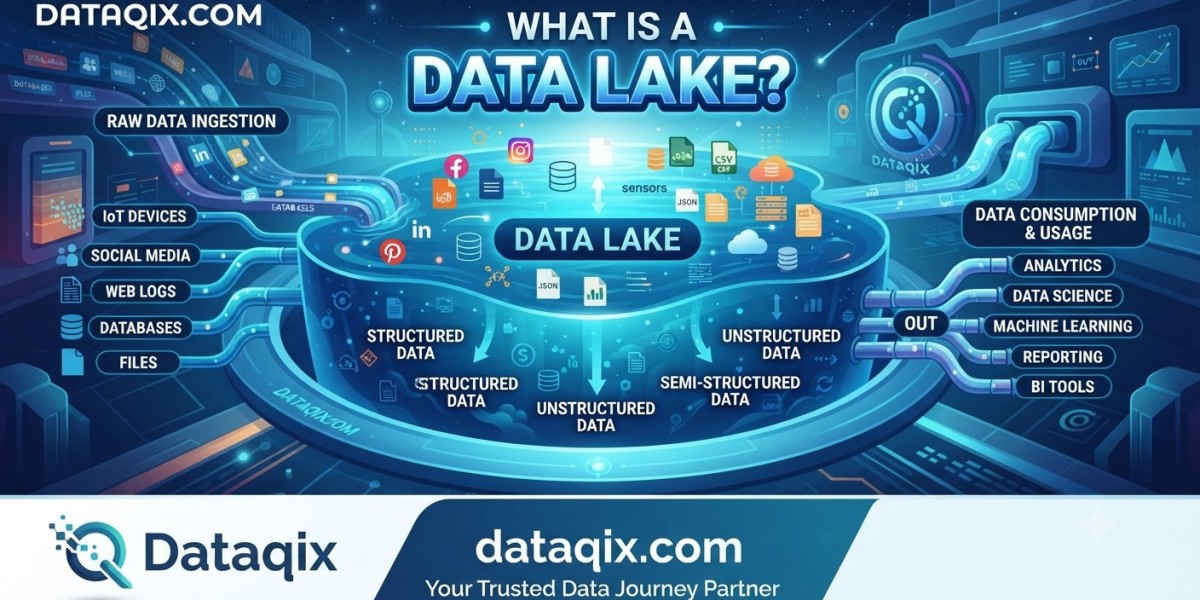

Businesses generate large amounts of information every day through websites, applications, customer transactions, social media, and business operations. Managing this information efficiently is important for making better decisions and identifying useful trends. One solution that helps organizations store and manage large volumes of information is a data lake.
A data lake provides a flexible environment for storing data in its original format, whether structured, semi-structured, or unstructured. It allows businesses to collect information from different sources and use it for analytics, reporting, machine learning, and other data-driven activities.
What Is a Data Lake?
A data lake is a centralized storage repository designed to hold large amounts of raw data in its original format until it is needed for processing or analysis.
Unlike traditional databases, which generally require data to follow a predefined structure, a data lake can store different types of information without requiring immediate transformation.
For example, a company can store customer records, website activity, product images, PDF documents, transaction details, and social media data in the same data lake.
This flexibility makes data lakes useful for organizations that handle diverse and continuously growing datasets.
How Does a Data Lake Work?
A data lake collects information from multiple sources and stores it in a centralized environment. The stored information can later be processed, organized, and analyzed according to business requirements.
The process generally involves four steps:
Data collection: Information is gathered from applications, databases, websites, sensors, and other sources.
Data ingestion: The collected information is transferred into the data lake through batch or real-time pipelines.
Data storage: Data is stored in its original format, including structured, semi-structured, and unstructured formats.
Data processing and analysis: Analytical tools, machine learning systems, and business intelligence platforms access the stored information to generate insights.
This approach allows organizations to use their data for different purposes without maintaining separate storage systems for every data type.
Understanding Data Lake Architecture
Data lake architecture refers to the structure and components that work together to collect, store, process, secure, and analyze information.
A typical architecture includes the following layers:
1. Data Ingestion Layer
This layer collects information from different sources, such as databases, applications, APIs, and IoT devices.
2. Storage Layer
It provides scalable storage for large datasets in their original formats. Cloud storage and distributed storage systems are commonly used.
3. Processing Layer
This layer cleans, transforms, and prepares information for further use. It may also support large-scale data processing.
4. Analytics Layer
Data analysts and business teams use reporting tools, SQL engines, and machine learning platforms to extract useful insights.
5. Security and Governance Layer
This layer manages access permissions, data quality, privacy, metadata, and compliance requirements.
Together, these components help maintain an organized and reliable data environment.
Key Benefits of Data Lakes
Organizations use data lakes because they offer several practical advantages:
Flexible storage: Store structured, semi-structured, and unstructured data together.
Scalability: Handle growing data volumes without redesigning the entire storage system.
Cost efficiency: Cloud-based storage options can help manage infrastructure costs.
Advanced analytics: Support machine learning, artificial intelligence, and predictive analytics.
Better decision-making: Make information from multiple sources available for business analysis.
Data Lake vs. Traditional Data Warehouse
A data lake and a data warehouse serve different purposes.
A data lake stores raw information in different formats, while a traditional data warehouse generally stores structured, processed data prepared for reporting and business analysis.
Businesses often use both solutions together. A data lake provides flexible storage, while a data warehouse supports consistent reporting and structured queries.
Where Are Data Lakes Used?
Data lakes are useful across several industries:
Healthcare: Managing medical records, research data, and imaging files.
Retail: Analyzing customer behavior, sales, and product information.
Finance: Processing transaction records and identifying unusual activities.
Manufacturing: Collecting equipment sensor data and monitoring production.
E-commerce: Studying website traffic, customer preferences, and purchasing patterns.
Conclusion
A data lake is a flexible and scalable solution for storing large volumes of information from different sources. Its ability to manage structured, semi-structured, and unstructured data makes it valuable for modern businesses.
By implementing suitable data lake architecture, organizations can improve data management, support advanced analytics, and make more informed decisions. With proper security, governance, and data quality practices, data lakes can become an important foundation for data-driven business growth.
Visit us: https://dataqix.com/