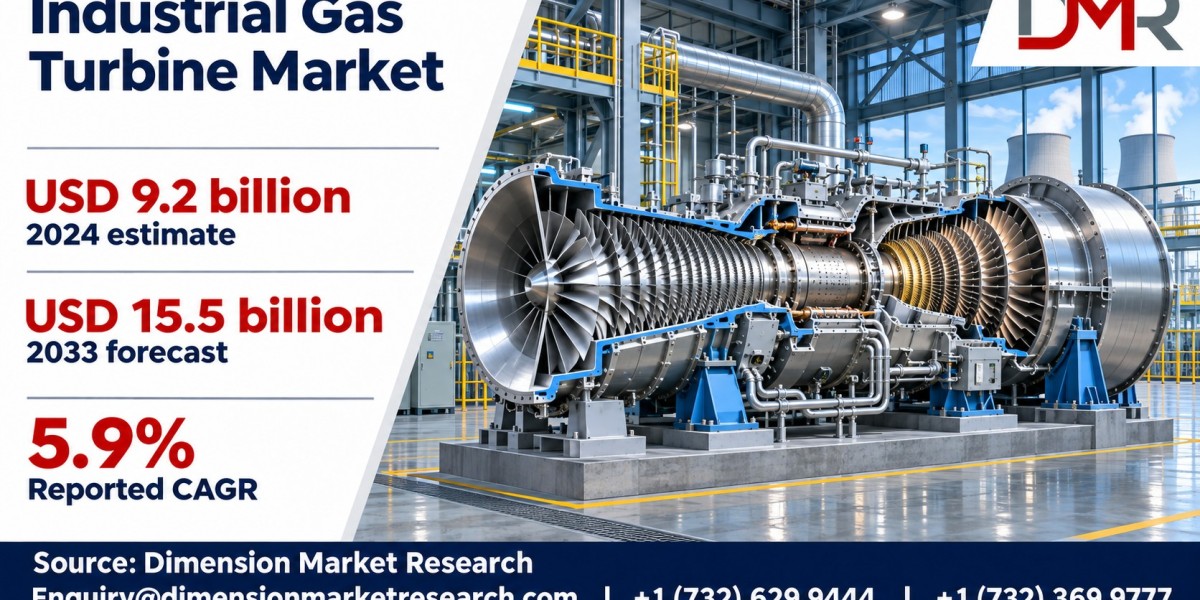

The Industrial Gas Turbine Market is expanding as utilities and industrial operators invest in reliable generation, on-site power, and equipment that can respond quickly to changes in demand. According to Dimension Market Research, the report’s Market Overview estimates the global market at USD 9.2 billion in 2024 and projects it to reach USD 15.5 billion by 2033, at a 5.9% CAGR. The article follows the 2024 to 2033 period used in the Market Overview and Key Takeaways. The Report Details table assigns the same values to 2023 and 2032.
The market serves buyers with different operating needs. A utility may need equipment that starts quickly when electricity demand rises. A plant that runs for long hours may place greater weight on fuel efficiency. An offshore operator may prioritize reliable on-site power and mechanical drive capability. Those differences help explain why the report examines turbine capacity, product design, generation technology, and application separately.
What Is the Industrial Gas Turbine Market?
The market covers turbines used to generate electricity or provide mechanical power in industrial settings. In a power plant, the turbine drives a generator. In oil and gas operations, it can supply electricity at a production site or drive equipment such as a gas compressor. The report also covers manufacturing applications where operators need power and process steam.
Download a Free Industrial Gas Turbine Market Report Sample
https://dimensionmarketresearch.com/request-sample/industrial-gas-turbine-market/
Power Generation Leads Industrial Gas Turbine Demand
Power generation accounted for approximately 55% of the global market in 2023, making it the largest application in the report. Growing electricity demand, industrialization, and the need for reliable supply support investment in both centralized and distributed generation. Gas turbines’ ability to start quickly makes them relevant for sites that need backup capacity and for grids that need additional generation during periods of peak demand.
Oil and gas operators use turbines for power generation and gas compression at production and processing facilities. Offshore platforms are one example of where reliable local generation matters. In manufacturing, the report highlights applications in chemicals and textiles, where turbines can be incorporated into systems that also supply process steam. For buyers, the potential to use both electricity and heat can change the economics of an on-site installation.
Aero-Derivative and Heavy-Duty Turbines Serve Different Operating Needs
Aero-derivative turbines represented approximately 55% of global market share by product in 2023. The report attributes their position to quick startup and flexibility, which make them useful for peaking plants, backup installations, and other operations with variable power requirements. It also identifies the capacity class of 70 MW or less as a significant segment, supported by demand from smaller plants and distributed power projects.
Heavy-duty turbines are suited to applications that require sustained, high-output operation. The report points to utilities and large industrial facilities as important buyers. For procurement teams, that distinction makes the intended operating schedule a starting point for comparing machines. A turbine intended for frequent starts faces a different set of operating priorities from one that is expected to deliver a consistent output over long runs.
Open Cycle Leads, While Combined Cycle Recovers More Energy
Open-cycle technology accounted for approximately 65% of the market by technology in 2023. The report associates this position with a straightforward configuration and rapid response, particularly where operators need to add generation during short periods of peak demand. Combined-cycle plants use heat from the gas turbine’s exhaust to produce steam and generate additional electricity. Recovering that heat improves fuel efficiency and can make a greater difference at sites that operate for longer periods.
Fuel prices, overhaul costs, and operating schedules can all affect the economics of a project. The report also identifies digital monitoring and predictive maintenance as areas of investment. For operators, the commercial value lies in using operating data to plan service work and reduce unplanned downtime, particularly where a turbine supplies a facility that depends on continuous power.
North America Leads as Local Power Needs Shape Regional Opportunities
North America accounted for approximately 40% of global market share in 2023, supported by established natural gas infrastructure and investment in generation modernization. The report highlights combined-cycle investment in Europe and links demand in Asia-Pacific to industrial growth and rising electricity needs in markets such as China and India. It also identifies opportunities in distributed generation and in hybrid systems where gas turbines can provide electricity when wind or solar output falls.
The competitive landscape includes General Electric (GE), Siemens, Mitsubishi Hitachi Power Systems, Ansaldo Energia, and Solar Turbines, as named in the report. The companies’ offerings span utility-scale combined-cycle equipment, industrial and oil and gas applications, and digital maintenance capabilities. Their range reflects what buyers evaluate over the life of a project, including efficiency, availability, and access to service.
Get the Full Industrial Gas Turbine Market Report
https://dimensionmarketresearch.com/checkout/industrial-gas-turbine-market/
Frequently Asked Questions
How large is the Industrial Gas Turbine Market?
The report’s Market Overview estimates the global market at USD 9.2 billion in 2024 and projects it to reach USD 15.5 billion by 2033.
What is the projected Industrial Gas Turbine Market CAGR?
The Market Overview projects a CAGR of 5.9% from 2024 to 2033.
Which application leads the Industrial Gas Turbine Market?
Power generation led in 2023, accounting for approximately 55% of the global market.
Which region led the Industrial Gas Turbine Market?
North America held the largest regional share in 2023 at approximately 40%. The report attributes that position to established energy infrastructure and widespread natural gas use.
What is the difference between open-cycle and combined-cycle gas turbines?
An open-cycle system generates power directly from the gas turbine. A combined-cycle system also recovers heat from the turbine exhaust to produce steam and generate additional electricity.
Conclusion
The outlook through 2033 reflects demand for quick-start generation, reliable industrial power, and higher fuel efficiency. For utilities and industrial operators, the investment decision comes down to how a turbine will be used: how often it must start, how long it will run, and whether the site can use recovered heat. Those operating needs shape the opportunity for equipment suppliers and the long-term economics for buyers.