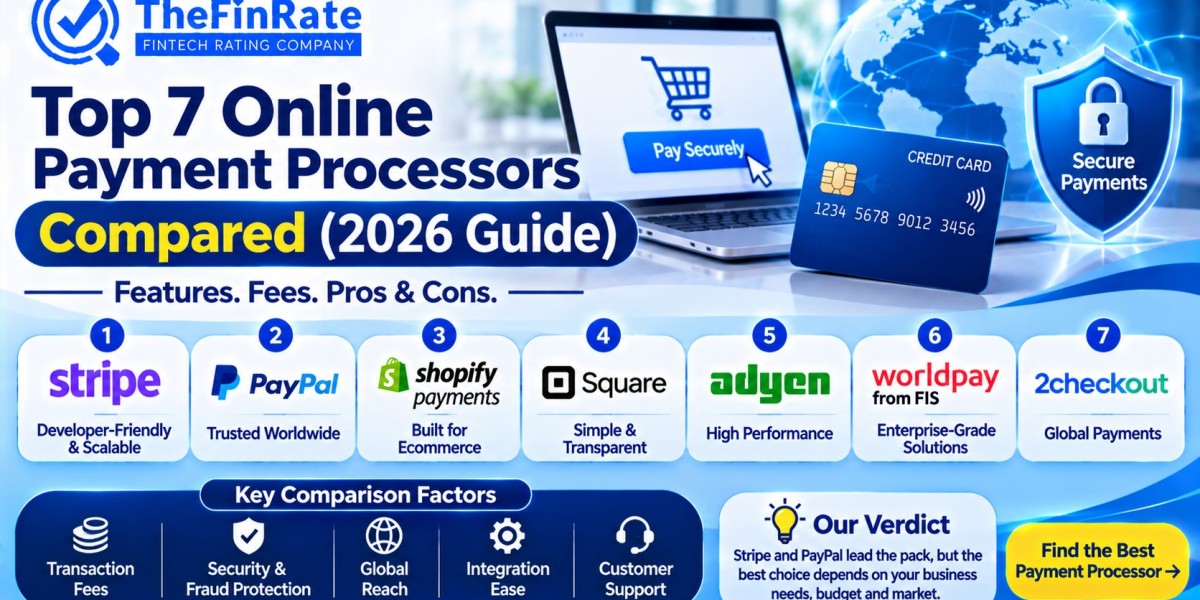

Choosing between online payment processing services is less about finding a universal winner and more about matching a provider to how you sell. A solo store owner, a SaaS company billing in five currencies and an enterprise running global checkout all need different things from the same category of software. This guide compares seven widely used providers by what each does best, where each falls short and who should shortlist it.
Quick Answer
- Best for developers and custom checkout: Stripe
- Best for trust and first-time buyers: PayPal
- Best for selling online and in person: Square
- Best for Shopify stores: Shopify Payments
- Best for transparent, volume-based pricing: Helcim
- Best for enterprises and omnichannel: Adyen
- Best for cross-border and multi-currency: Airwallex
These are "best for" picks based on published features and pricing models, not a ranking from hands-on testing. Fees change often, so confirm current rates on each provider's pricing page before deciding.
How We Compared Them
Each provider was judged on the factors that affect real businesses:
- Pricing model and how clear it is
- Supported countries, currencies and payment methods
- Integrations and developer tools
- Fraud and chargeback tools
- Payout speed and account stability
- Fit for different business sizes
Comparison at a Glance
| Provider | Best for | Pricing model | Main trade-off |
|---|---|---|---|
| Stripe | Custom checkout and APIs | Flat rate, custom at scale | Needs technical resources for advanced setups |
| PayPal | Buyer trust and quick start | Flat rate | Dispute and hold policies can frustrate sellers |
| Square | Online plus in-person | Flat rate | Online rates can cost more than competitors |
| Shopify Payments | Shopify merchants | Flat rate, plan-linked | Only for Shopify stores |
| Helcim | Growing volume | Interchange-plus | Fewer extras than larger platforms |
| Adyen | Enterprise and global | Interchange-plus style | Less suited to very small merchants |
| Airwallex | Cross-border and FX | Transparent, multi-currency | Newer in some markets |
1. Stripe: Best for Developers and Custom Checkout
Stripe is a popular choice for online businesses that want control over the checkout experience. Its APIs, hosted checkout and billing tools suit SaaS, marketplaces and subscription models, and it supports a wide range of currencies and payment methods.
Strengths: flexible APIs, strong documentation, subscription and invoicing tools, broad integrations.
Limits: advanced use cases need developer time, and holds or reviews can occur if activity looks unusual.
Suits: startups, SaaS and eCommerce teams with technical support.
2. PayPal: Best for Buyer Trust
Many customers already have a PayPal account, which can reduce checkout friction and help conversion, especially for new or lesser-known stores. It is quick to add and works across many countries.
Strengths: high consumer recognition, easy setup, buyer and seller protection programs.
Limits: funds can be held during disputes, and fees on some transaction types can add up.
Suits: small merchants, first-time sellers and stores that want a trusted extra payment option.
3. Square: Best for Online Plus In-Person Sales
Square started with point-of-sale and now covers online checkout, invoicing and payment links in one system. That makes it a practical choice when you sell in a shop, at events and online and want a single dashboard.
Strengths: unified in-person and online reporting, simple onboarding, no long contracts on standard plans.
Limits: online rates can be higher than some competitors, and international reach is narrower than global-first providers.
Suits: retail, service businesses and hybrid sellers.
4. Shopify Payments: Best for Shopify Stores
If your store runs on Shopify, its built-in payment service removes the need to connect a separate gateway. Checkout, payouts and reporting sit inside the same admin.
Strengths: native integration, simple setup, consistent reporting.
Limits: available only in supported countries and only for Shopify merchants, and using a third-party gateway can bring extra charges.
Suits: Shopify sellers who want the simplest path.
5. Helcim: Best for Transparent, Volume-Based Pricing
Helcim uses interchange-plus pricing, where you pay the actual card network cost plus a small markup. Rates tend to fall as monthly volume grows, so it can become attractive as sales increase.
Strengths: pricing that is easier to audit, no long-term lock-in on standard plans, support for online and in-person payments.
Limits: available in fewer countries than the largest providers and with fewer add-on tools.
Suits: growing small and mid-sized businesses focused on cost control.
6. Adyen: Best for Enterprises and Omnichannel
Adyen is built for large merchants that need global acquiring, unified commerce and sophisticated risk controls in one platform. It handles online, in-app and in-store payments and many local payment methods.
Strengths: global coverage, strong fraud tools, unified data across channels.
Limits: onboarding and minimum volume expectations make it less suitable for very small merchants.
Suits: enterprises, large marketplaces and fast-scaling international brands.
7. Airwallex: Best for Cross-Border and Multi-Currency
Airwallex combines payment acceptance with multi-currency accounts and international transfers. It is aimed at businesses that sell across borders and want to reduce currency conversion costs.
Strengths: multi-currency balances, transparent FX approach, useful for global sellers and fintechs.
Limits: product availability varies by region, so confirm eligibility for your country and business type.
Suits: cross-border eCommerce, SaaS and businesses with international suppliers or customers.
Pricing Models Explained
Flat rate: one percentage plus a fixed fee per transaction. Easy to predict, but often more expensive as volume grows.
Interchange-plus: the card network cost plus a fixed markup. More transparent and usually cheaper at higher volume, but harder to forecast.
Custom or enterprise pricing: negotiated rates for high volume, often with contracts and minimums.
Always check extra costs: chargeback fees, currency conversion, payout fees, monthly fees and any reserves.
How to Choose the Right Service
- Map your sales channels: online only, in person or both.
- List your target countries and the currencies and local payment methods customers expect.
- Estimate monthly volume and average order value to compare flat-rate against interchange-plus.
- Check your industry is accepted. Some sectors are treated as higher risk, and our guide to merchant account providers explains the alternatives.
- Test the checkout on mobile and run a small pilot before moving all traffic.
- Plan a backup provider once revenue depends heavily on one account.
Common Mistakes to Avoid
- Picking on the headline rate alone and ignoring currency conversion, chargeback and payout fees.
- Not disclosing your full business model, which can lead to a frozen account later.
- Relying on one processor with no fallback.
- Skipping the contract terms on reserves, holds and termination.
- Ignoring local payment methods in the markets you want to grow in.
Frequently Asked Questions
What is the best online payment processing service overall?
There is no single best option. Stripe suits custom builds, PayPal suits trust, Square suits hybrid sellers and Adyen suits enterprises. The best fit depends on your channels, countries and volume.
What is the difference between a payment processor and a payment gateway?
A gateway securely captures and transmits payment data from your checkout. A processor moves the transaction between the card networks and banks. Many providers bundle both.
Are flat-rate or interchange-plus fees better?
Flat rate is simpler for low volume. Interchange-plus is usually more cost-effective and transparent as volume grows.
Can I use more than one payment processor?
Yes. Many businesses add a second provider for redundancy, better approval rates and local payment methods.
Do I need a merchant account?
Not always. Many providers let you start under their master account, while larger or higher-risk businesses may prefer a dedicated merchant account.
How long does approval take?
Many providers approve standard businesses within days, sometimes faster. Higher-risk or regulated industries can take longer and need more documents.
Final Verdict
The best online payment processing service is the one that matches your sales channels, target markets and growth stage. Start with a shortlist of two or three providers, compare the total cost rather than the base rate, and test the checkout before you commit. Review your setup each year, because the cheapest option at low volume is rarely the cheapest at scale.
Want to compare more providers side by side? Browse TheFinRate's payment gateway reviews or start at TheFinRate to build your shortlist.