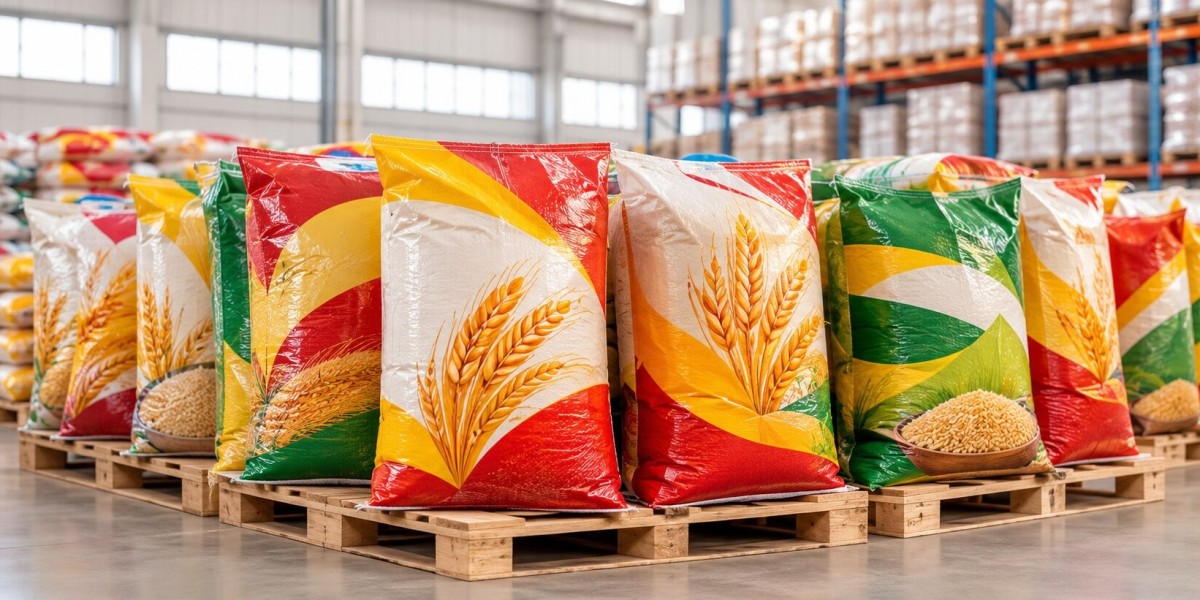

Your bag is often the first thing a buyer sees on a shelf or in a warehouse. A sharp, glossy BOPP bag tells them the product inside is cared for. A faded or peeling one says the opposite.
Custom BOPP bags give you strong packaging and retail-quality print in one. But the results depend on choices you make before the first bag is made. This guide walks through printing, lamination and the key specs. It also covers what to confirm with your BOPP bags manufacturer before you sign off on artwork.
What Are BOPP Bags?
A BOPP bag has two layers. The inner layer is woven polypropylene fabric, which carries the load. The outer layer is BOPP film, short for biaxially oriented polypropylene. The film is printed and then laminated onto the fabric.
The fabric gives strength. The film gives a smooth surface for print and adds a barrier against moisture and dust. Together, they make a bag that can carry heavy loads and still look like a retail pack.
Printing: Getting Your Brand Right
Most custom BOPP bags are printed by rotogravure. Each colour is engraved on its own metal cylinder. The cylinders transfer ink onto the film in perfect register, one colour after another.
The ink is printed on the reverse side of the film. After lamination, the ink sits between the film and the fabric. That means it does not scratch or rub off during handling, stacking or transport.
Keep these points in mind when you plan your artwork:
Number of colours: multi-colour designs and photo-quality images are possible. Each extra colour adds a cylinder and some cost.
Artwork files: share vector files at full size, with fonts outlined and colours clearly marked.
Colour matching: give Pantone references for brand colours, and ask for a printed proof before the run.
Print area: leave space for the stitched bottom and the top hem so key text is not cut or hidden.
Mandatory text: plan room for batch numbers, net weight, barcodes and any legal labels your market needs.
Cylinder cost: cylinders are a one-time cost per design. Reorders of the same design reuse them.
Lamination: Choosing the Right Finish
The film finish changes how your bag looks and feels. It also affects grip when bags are stacked. Common options include:
Gloss: bright, vivid colours and a premium shine. Popular for rice, flour and pet food.
Matte: a soft, modern look with less glare. It reads well under strong store lighting.
Metallised: a silver or reflective effect for high-end packs.
Transparent window: a clear panel so buyers can see the product inside.
Anti-slip coating: adds grip so stacked bags stay put on pallets and in trucks.
Lamination also adds a moisture barrier. If your product needs to breathe, ask about micro-perforation. Small holes let air escape during filling and help some products stay fresh.
Key Specs to Confirm
Print and finish get the attention. But specs decide whether the bag survives the supply chain. Confirm these with every quote:
Fabric GSM: the weight of the woven layer. Match it to your fill weight and how high you stack.
Film thickness: measured in microns. Thicker film gives a tougher surface and richer print.
Bag size and gusset: width, length and side folds, set by fill weight and product density.
Bottom type: block bottom bags stand upright and stack neatly. Stitched bottoms suit standard filling lines.
Top finish: open mouth, valve, or easy-open options for the end user.
Handles and liners: loop handles for small retail packs, and inner liners for fine or sensitive products.
UV treatment: needed if filled bags sit outdoors before sale.
Ask for samples and run them on your own filling line. Fill, seal, stack and ship a few. Real handling shows problems that a spec sheet cannot.
Where Custom BOPP Bags Work Best
BOPP bags fit any product that needs both strength and shelf appeal. Common uses include rice and food grains, flour and sugar, pet food and animal feed, seeds, fertilisers and some chemicals.
For low-cost bulk transport with no retail display, plain PP woven bags may serve you better. Both formats have their place. The right choice depends on where your bag will be seen and how it will be handled.
Questions to Ask a BOPP Bags Manufacturer
A great design only works if every batch matches it. Before you place an order with any BOPP bags manufacturer, ask:
Do you weave, laminate and print in-house, or outsource any step?
Can I see a printed proof and a physical sample before the full run?
What is the MOQ per design, and how does it change on reorders?
What lead time should I plan for new cylinders and for repeat orders?
How do you keep colours consistent from batch to batch?
Which certifications do you hold, and how do you pack for export?
Why In-House Control Matters
Every handover between suppliers adds a chance for colour drift, weak lamination or size errors. When weaving, lamination and printing happen under one roof, the supplier can control each step and fix issues fast.
Mewar Polytex has made woven packaging since 1979. With 46+ years in business, 14+ manufacturing facilities and over 8,000 MT of monthly capacity, it handles weaving, lamination, printing, stitching and finishing in-house. The company is ISO 9001 certified, an EFIBCA member, and exports to 25+ countries.
Great custom BOPP bags come from a clear brief: sharp artwork, the right finish and specs matched to your load. Lock those in, test samples, and choose a BOPP bags manufacturer that can deliver the same quality on every order.