
Hair loss rarely announces itself. A parting that looks a little wider, temples that creep back a few millimetres a year, a crown that shows through under bathroom lighting. By the time most people start reading about a hair transplant, they have usually been watching the change for years. Then the research begins, and the internet offers two extremes: glossy before-and-after photos on one side, horror stories about unnatural hairlines on the other. The reality sits somewhere between, and it starts with understanding what the operation actually does.
A hair transplant moves your own growing hair from one part of the scalp to another. It does not create new follicles. That single fact explains almost everything else: why planning matters so much, why donor hair has to be treated as a limited resource, and why a proper consultation should come before any decision about price or technique. If you are looking into a hair transplant in Islamabad, this guide covers the fundamentals in plain language so you can walk into that first appointment informed rather than overwhelmed.
What a Hair Transplant Actually Does
During the procedure, a surgeon removes healthy follicles from a donor area, usually the back and sides of the scalp, and places them into the thinning or bald parts, known as the recipient area.
The reason this works lies in how common pattern hair loss behaves. In androgenetic alopecia, follicles on the top and front of the scalp gradually shrink in response to hormones, particularly dihydrotestosterone (DHT). Follicles at the back and sides are generally more resistant. When they are moved, they tend to keep that resistance, which is why transplanted hair can keep growing in its new home.
Two practical consequences follow. First, you are redistributing a finite supply, so the number of grafts that can be taken safely is limited. Specialists increasingly describe the “safe” donor zone as something that varies from patient to patient rather than a fixed template. Second, hair that was not transplanted can continue to thin over the years. A sound plan accounts for the hair loss you may have in a decade, not only the hair loss you have today.
The Main Techniques: FUE, DHI and FUT
Techniques differ mainly in how follicles are harvested and how they are placed.
FUE (Follicular Unit Extraction)
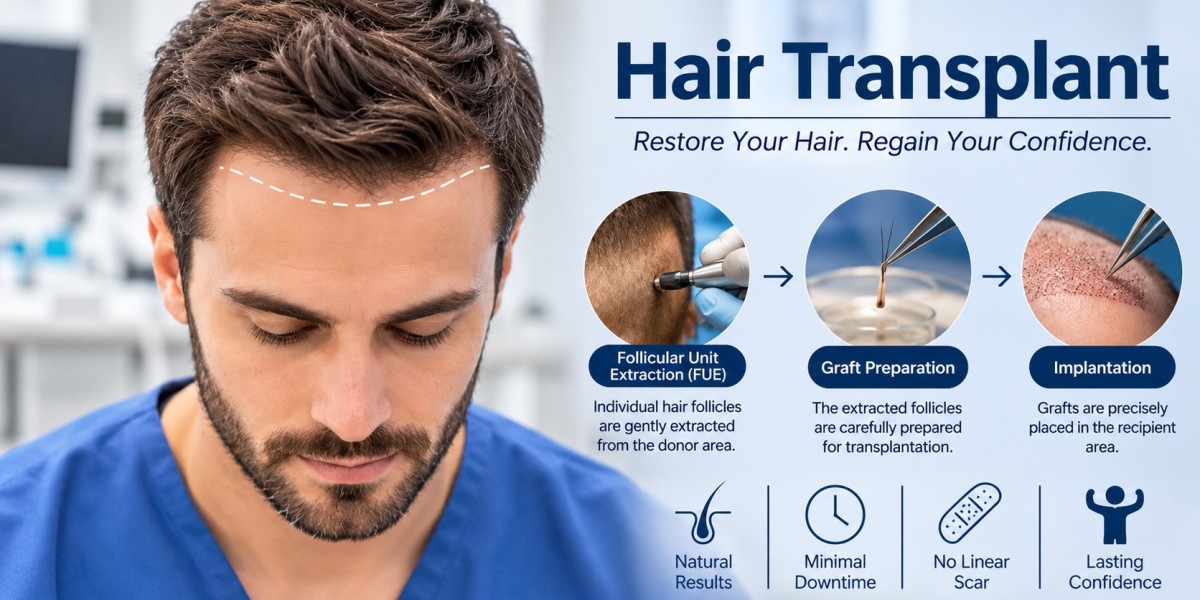
In FUE, the surgeon extracts follicular units one at a time with a tiny punch tool. Each extraction leaves a small dot-like mark that is usually hidden once the hair grows back, with no linear scar and no stitching at the donor site. It is the most widely requested method today, and it is the reason short haircuts remain possible for many patients afterwards.
DHI (Direct Hair Implantation)
DHI is a close relative. Follicles are typically extracted as in FUE, then loaded into a pen-like implanter and placed directly, which gives the surgeon control over angle and depth. Some clinics promote DHI as clearly superior. The evidence for that is less settled than the marketing suggests, and the surgeon’s planning and skill usually matter more than the name of the technique.
FUT (Follicular Unit Transplantation)
FUT, often called the strip method, removes a thin strip of scalp from the back of the head and divides it into grafts under magnification. The donor wound is stitched, which leaves a fine linear scar. FUT can still make sense for some patients, for example when a surgeon wants a large number of grafts in one session, but the scar can show with very short hair, so it deserves an honest conversation.
FUE | DHI | FUT | |
Donor harvest | Individual follicles | Individual follicles | Strip of scalp |
Donor scar | Tiny dots | Tiny dots | Linear |
Stitches at donor | No | No | Yes |
Placement | Surgeon-made sites | Implanter pen | Surgeon-made sites |
Who Is a Good Candidate?
Suitability is individual, but surgeons typically look for:
A diagnosed and reasonably stable pattern of hair loss
Enough healthy donor hair to cover the planned area
Realistic goals for density and hairline position
General health that allows minor surgery
Some situations need extra care:
Younger patients. ISHRS FUE guidelines advise caution below roughly 25, because future hair loss is hard to predict and that affects donor planning.
Diffuse thinning, where the donor area is thinning too. This is more common in women and usually needs a medical work-up first.
Scarring or autoimmune hair loss, such as alopecia areata, which needs a diagnosis and stability before any surgery is considered.
Expectations the donor supply cannot meet, such as a very low, dense hairline across a large bald area.
What Happens on the Day
Most hair transplants are outpatient procedures and can take several hours, depending on how many grafts are planned. Details vary between clinics, but the sequence is usually:
Hairline design. The surgeon marks a hairline that suits your face, age and likely future loss.
Local anaesthesia. The scalp is numbed, so most patients feel pressure rather than pain.
Harvesting. Follicles are removed by FUE or, less commonly, by strip excision.
Graft preparation. Grafts are sorted under magnification and kept in a holding solution.
Recipient sites. Tiny incisions are made in the direction and angle of natural growth.
Implantation. Grafts are placed one by one.
Aftercare briefing. You leave with written instructions on washing, sleeping and activity.
Recovery and Results in Brief
Expect redness and small scabs for the first week or two. Many people return to desk work within days to about a week, though this varies with the person and the job. The transplanted hair shafts usually shed within the first few weeks, which is normal. New growth tends to begin at around three months, and the full result can take up to a year or longer to appear.
Risks and Side Effects
A hair transplant is surgery, and all surgery carries risk. Recognised possibilities include:
Bleeding or infection
Temporary numbness or tightness of the scalp
Swelling of the forehead or face
Scarring at the donor or recipient site
Poor growth of some grafts
An unnatural-looking result
The best protection is a qualified surgeon, a donor-conscious plan and careful adherence to aftercare. Taking too many grafts from one area can leave the donor region looking thin, which is why a surgeon who talks about limits is usually a good sign.
Other Options Alongside or Instead of Surgery
A transplant does not treat the underlying cause of hair loss. Doctors may also discuss prescription medical treatments, PRP injections, scalp micropigmentation or hair systems, depending on the diagnosis. Each has benefits and limits, and a doctor should examine your scalp and confirm the cause of your hair loss before recommending any of them.
Preparing for a Consultation
A few things make the appointment far more useful:
Bring a list of medications and any medical conditions.
Note when the thinning began and whether relatives have similar patterns.
Find photos of your hair from a few years ago.
Write down your goals and your worries.
Then ask: Who will perform the extraction and the implantation? How many grafts do I need and how was that number reached? What happens if my hair loss progresses? What should I realistically expect?
Frequently Asked Questions
Is a hair transplant permanent?
Transplanted follicles are generally long-lasting because they come from areas resistant to pattern hair loss. Your existing, non-transplanted hair may still thin, so permanence of the overall look is not guaranteed.
Is a hair transplant painful?
The procedure is normally done under local anaesthesia, so most patients feel pressure rather than sharp pain. Some soreness, tightness or numbness can follow, and your surgeon will advise on pain relief.
How many grafts will I need?
It depends on the size of the area, the density you want and how much donor hair you have. A surgeon can only estimate this after examining your scalp, so treat online graft calculators as rough guides.
Can women have a hair transplant?
Some can. Many women have diffuse thinning that affects the donor area as well, so a medical assessment to find the cause comes first. Women with a stable, localised pattern, such as a high hairline or traction-related loss, are more likely to be suitable.
When will I see results?
Transplanted hair usually sheds first, and new growth generally begins around three months. Final results can take up to a year or more.
Will I still need treatment afterwards?
Possibly. Because existing hair can keep thinning, some surgeons recommend continuing medical therapy or planning a later session. This is individual to each patient.
Final Thoughts: Start With Information, Not a Package
A hair transplant works best when the plan fits your hair, your donor supply and your expectations. Taking time to understand the options before you sit in a consultation gives you better questions and better protection against overpromising.
If your consultation points towards removing follicles one at a time, read more about FUE hair transplant, then book an assessment with a qualified surgeon who can examine your scalp in person. Suitability, results and recovery differ from person to person, so no article, including this one, can replace that conversation.